Table of Content
Table of Contents
Beauty and self-care are closely connected because both involve personal routines.
A skincare routine can be five minutes long. A wash-day routine can take considerably longer. A body-care ritual might simply mean taking a longer shower and applying moisturizer afterward.
The important part is not how elaborate the routine looks on social media. It is whether it works for you.
Black-owned beauty products can add another dimension to that experience. They give consumers an opportunity to discover businesses created by Black founders and entrepreneurs while exploring products designed for different skin tones, hair textures, and personal preferences.
This does not mean every Black-owned product is automatically better for everyone. Product quality still matters. Ingredients, formulation, price, packaging, usage instructions, and suitability should all be considered.
That distinction is important.
Supporting a Black-owned business and choosing a product that works for your needs can happen at the same time.
Recent consumer research also shows that Black beauty shoppers continue to influence categories such as fragrance, body care, skincare, and wellness. NIQ reported in 2026 that Black consumers represented 12.8% of dollar sales and 13.1% of buyers across total beauty and personal care, with fragrance, bath and shower, and body care among notable areas.
So, whether you are searching for a moisturizer, hair mask, body oil, fragrance, or wellness item, there is a growing range of options to explore.
What to Include in a Self-Care Beauty Routine
You do not need ten different products.
A simple routine can be built around four areas:
Category | What to Look For | When It Fits |
|---|---|---|
Skincare | Cleanser, moisturizer, sunscreen | Morning or evening |
Haircare | Shampoo, conditioner, mask, styling product | Wash day |
Body care | Body wash, lotion, oil, scrub | Shower or evening |
Wellness | Supplements, relaxation products, personal-care items | Based on individual needs |
The best combination depends on your lifestyle.
Someone with dry skin may prioritize a gentle cleanser and richer moisturizer. Someone focused on hair maintenance may spend more time on conditioning and scalp care. Another person may find that a simple shower, body lotion, fragrance, and quiet music provide enough of a reset.
Self-care should fit your life rather than create another obligation.
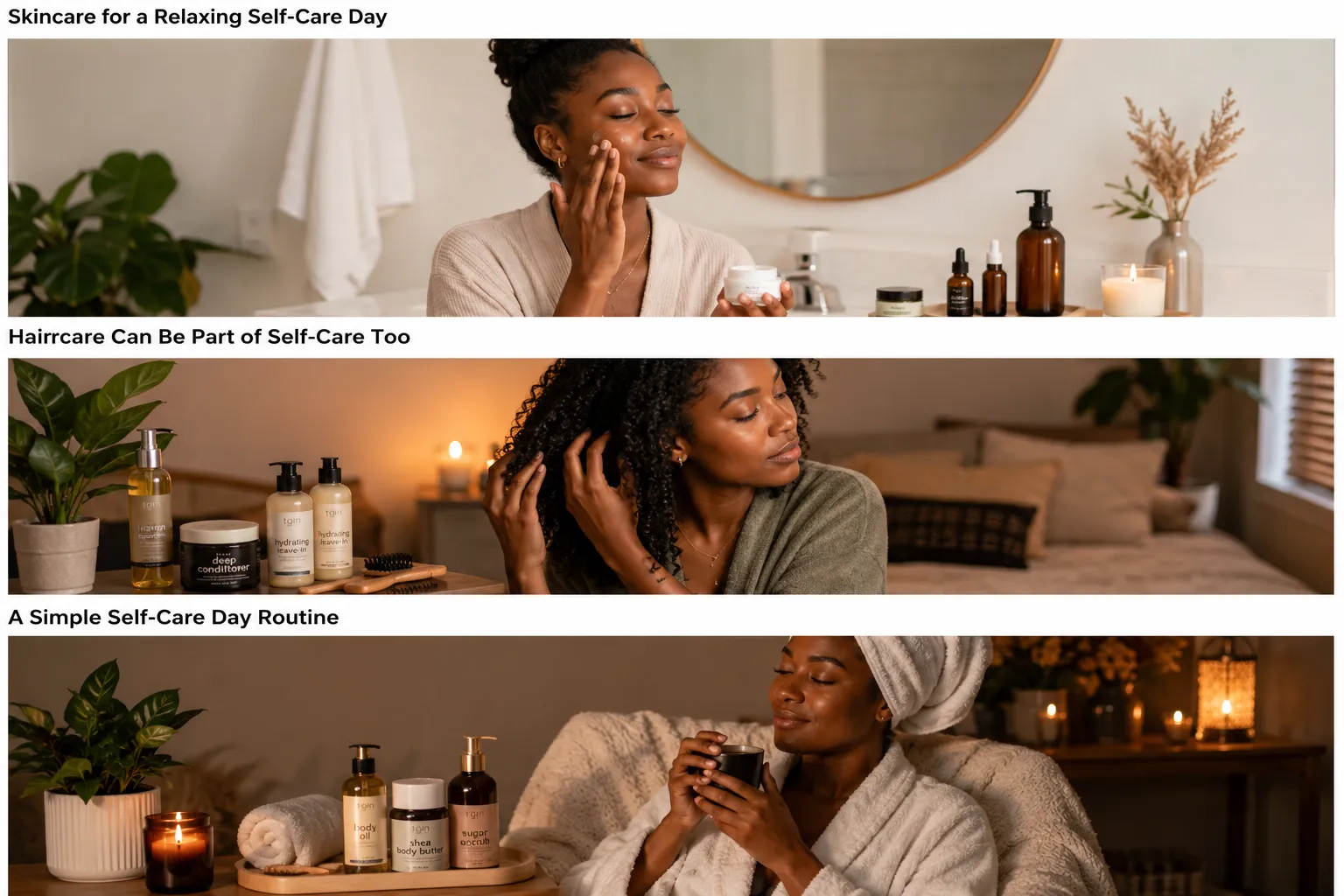
Skincare for a Relaxing Self-Care Day
Skincare is often the centerpiece of a self-care routine.
However, more products do not automatically mean better skin.
A basic routine usually needs cleansing, moisturizing, and daytime sun protection. The American Academy of Dermatology recommends broad-spectrum, water-resistant sunscreen with SPF 30 or higher for outdoor exposure.
For darker skin tones, sunscreen can be especially relevant when managing concerns such as hyperpigmentation. The AAD notes that visible light can contribute to dark spots and recommends tinted sunscreen containing iron oxide alongside SPF 30 or higher for additional visible-light protection.
Start With Your Skin Type
Before buying a product, consider whether your skin tends to be:
Dry
Oily
Combination
Sensitive
Normal
Prone to breakouts
You do not have to identify your skin type perfectly.
Instead, pay attention to how your skin behaves after cleansing and throughout the day.
If your face feels tight after washing, a gentler cleanser and more moisturizing formula may be worth considering. If your skin becomes oily quickly, lightweight and non-comedogenic products may be more comfortable.
Read the Ingredient List
Packaging can make a product look appealing, but the ingredient list tells you much more.
The FDA explains that cosmetic ingredients generally must be listed using their common or usual names, typically in descending order of predominance.
That makes ingredient literacy a useful shopping skill.
You should also avoid assuming that words such as "natural," "organic," or "hypoallergenic" automatically mean a product is safer or better for your skin. The FDA specifically warns consumers not to make that assumption.
If your skin is sensitive, introduce one new product at a time. That makes it easier to identify what your skin does and does not tolerate.
Do Not Forget Sun Protection
A common misconception is that darker skin does not need sunscreen.
It does.
Melanin provides some natural protection, but it does not eliminate the need for sun protection. The AAD recommends sunscreen for people of all skin tones and notes that visible light can contribute to hyperpigmentation in darker skin.
For a self-care morning, sunscreen can be the final skincare step before makeup or heading outdoors.
Haircare Can Be Part of Self-Care Too
Haircare deserves a place in self-care because it can involve much more than appearance.
For many people, wash day is a chance to slow down and focus on maintenance. Detangling carefully, conditioning the hair, massaging the scalp, and taking time with styling can turn an ordinary routine into something more relaxing.
Black-owned haircare businesses have historically played an important role in creating products for textured hair and different styling needs.
However, hair type alone should not determine what you buy.
Consider:
Hair density
Curl pattern
Porosity
Scalp condition
Chemical processing
Heat styling
Protective styles
Current level of dryness or breakage
A product that works beautifully for one person may not produce the same result for another.
Build a Smaller Haircare Collection
Instead of buying every product in a collection, identify the problem you are trying to solve.
For example:
Dry hair: Look for conditioning and moisturizing products that suit your hair.
Frequent styling: Consider products designed around your styling method and heat exposure.
Protective styles: Focus on scalp and moisture maintenance appropriate for the style.
Wash day: A cleanser, conditioner, and suitable styling product may be enough.
This approach saves money and reduces product buildup.
It also makes it easier to understand which products are genuinely helping.
Body Care and Fragrance
A self-care routine does not have to stop at the face.
Body care can be one of the easiest ways to make an ordinary evening feel more intentional.
Consider a simple sequence:
Take a comfortable shower or bath.
Use a body cleanser that suits your skin.
Pat the skin dry instead of aggressively rubbing.
Apply body lotion or another moisturizer.
Add fragrance if you enjoy wearing it.
Put on comfortable clothes and slow down.
Body oils, lotions, soaps, scrubs, and fragrances can all fit into this routine.
The trick is moderation.
If you use multiple fragranced products at once, the combined scent may become overwhelming. People with sensitive skin may also prefer fragrance-free options.
The same principle applies here as with facial skincare: choose based on your needs rather than buying something simply because it is trending.
Wellness Products and Beauty Routines
Self-care can also include wellness.
That might mean vitamins, supplements, herbal products, personal-care essentials, or other products that support an individual's broader routine.
However, wellness products deserve more careful consideration than ordinary beauty purchases.
A supplement is not automatically necessary because it appears in a beauty-focused collection. Your nutritional needs depend on your diet, lifestyle, age, medications, and health circumstances.
If you are considering supplements, review the label and discuss appropriate products with a qualified healthcare professional when necessary.
Do not treat supplements as substitutes for medical care or a balanced diet.
For a marketplace such as ProBlack, the health and beauty category can be a convenient place to explore different everyday products, but shoppers should still evaluate each product individually rather than assuming that everything in a category serves the same purpose.
How to Choose Black-Owned Beauty Products
A Simple Self-Care Day Routine
Finding the right product becomes much easier when you use a simple decision process.
1. Define the Product You Actually Need
Start with the problem.
Do you need:
A moisturizer?
Hair conditioner?
Body lotion?
Sunscreen?
Makeup?
Fragrance?
A wellness product?
Avoid beginning with "What should I buy?"
Begin with "What am I trying to improve or maintain?"
That small change can prevent unnecessary purchases.
2. Check Who Owns the Business
If supporting Black-owned businesses is part of your shopping goal, check the company's current ownership rather than relying only on branding.
There is an important distinction between Black-founded and Black-owned businesses.
A company may have been founded by a Black entrepreneur but later acquired by another company. That does not erase its history, but it is different from current Black ownership.
For shoppers specifically seeking Black-owned businesses, verifying current ownership is therefore worthwhile.
3. Review Ingredients and Instructions
Read the product description and ingredient list.
Look for clear instructions, warnings, usage information, size, and relevant product details.
The FDA states that cosmetic labels must be truthful and not misleading.
Be particularly cautious when a cosmetic product makes dramatic claims about treating a disease or changing the structure or function of the body. Such claims can move a product into drug-regulatory territory.
4. Consider the Total Cost
The cheapest product is not always the best value.
A $12 product that you replace frequently may cost more over time than a $25 product that lasts longer and works better for your routine.
Look at:
Product size
Amount used per application
Frequency of use
Shipping
Return policies
Packaging
Expected shelf life
5. Start With One or Two Products
You do not need to completely replace your bathroom shelf.
Choose one product from a Black-owned brand or marketplace and see how it fits into your routine.
If it works, you can gradually explore other categories.
This is more practical than purchasing an entire collection at once.
6. Explore Black-Owned eCommerce Stores
Online marketplaces and independent stores can make discovery easier.
Instead of searching through hundreds of individual websites, shoppers can explore categories and compare products in one place.
That is one reason searches for black owned eCommerce stores can be useful for people who want to combine product discovery with intentional shopping.
The key is to still research the individual product.
A Simple Self-Care Day Routine
You can create a complete self-care day without turning it into a full-day project.
Morning: Start With the Basics
Begin with your regular skincare routine.
Cleanse if needed, moisturize, and apply sunscreen when appropriate.
Keep breakfast and hydration simple.
If you use supplements, follow the product directions and any advice provided by your healthcare professional.
Afternoon: Focus on Hair and Body Care
Set aside time for your hair.
You might wash, deep condition, detangle, moisturize, or simply refresh your current style.
Afterward, take a shower and follow with body moisturizer.
This is also a good time to try a body-care product you have been meaning to use.
Evening: Make It Enjoyable
Self-care does not need to end with another product.
Put your phone aside.
Read a book. Watch something you enjoy. Listen to music. Journal. Talk with someone you care about.
The products are supporting the routine, not replacing the actual rest.
A Practical Product Comparison
If you are unsure where to begin, this framework can help:
Product Type | Main Purpose | What to Consider | Best for |
Cleanser | Removes dirt, oil, and makeup | Skin type and sensitivity | Daily skincare |
Moisturizer | Supports skin hydration | Texture and skin needs | Morning/evening |
Sunscreen | Helps protect against UV exposure | SPF, broad spectrum, skin tone | Daytime |
Hair conditioner | Supports manageable, conditioned hair | Texture, dryness, styling routine | Wash day |
Body lotion | Moisturizes body skin | Texture and fragrance | After bathing |
Body oil | Adds emollience and sensory appeal | Skin preference and ingredients | Evening routines |
Fragrance | Adds scent to the routine | Strength and personal preference | Finishing step |
Wellness product | Supports a broader personal routine | Ingredients, dosage, suitability | Individual needs |
This table is a starting point, not a substitute for product-specific instructions or professional advice.
Common Mistakes to Avoid
Buying Too Many Products at Once
A shelf full of products can look impressive, but it can make your routine harder to manage.
Start small.
Choosing Products Only Because They Are "Natural"
Natural does not automatically mean safe or effective for every person.
The FDA specifically advises consumers not to assume that natural or organic ingredients are inherently safer.
Ignoring Sunscreen
This is particularly important for people with darker skin tones who may experience hyperpigmentation.
Sunscreen remains an important part of skin protection.
Assuming Black-Owned Means Suitable for Everyone
Black-owned products can be created for a wide range of consumers.
However, ownership does not tell you whether a particular formula is right for your skin, hair, or preferences.
Read the product information.
Following Every Beauty Trend
Trends change quickly.
Your skin and hair do not need to follow every new product launch.
A simple routine that you can maintain is usually more useful than a complicated routine that lasts two weeks.
Making Medical Claims About Beauty Products
Be cautious when a product promises to cure, treat, or prevent a medical condition.
Cosmetic and drug claims are regulated differently in the United States.
If you have a persistent skin or scalp concern, a qualified healthcare professional is a better source of medical guidance than a product description.
Where to Discover Black-Owned Beauty Products
There are several ways to discover Black-owned beauty businesses.
You can search directly for independent brands, explore curated retailer collections, or use marketplaces that bring products from different businesses together.
Large beauty retailers also maintain dedicated collections. For example, Sephora currently has a Black-owned beauty section covering categories such as skincare, haircare, makeup, and fragrance.
Independent directories and editorial buying guides can also help consumers discover newer brands.
For shoppers interested in black owned eCommerce stores, the important part is not simply finding a large list. It is finding businesses and products that genuinely fit your needs.
How ProBlack Can Help
ProBlack is built around Black-owned commerce and provides an online marketplace where shoppers can explore different product categories.
Its health and beauty section includes everyday products across beauty and wellness-related categories.
If you are already looking for personal-care or wellness products, browsing the category can be a practical starting point.
Rather than buying everything at once, choose products that solve a specific need and build your routine gradually.
Ready to explore? Browse the health and beauty selection on ProBlack's marketplace and compare products based on your own requirements.
Why Supporting Black-Owned Commerce Matters
Self-care is personal, but purchasing decisions also have an economic impact.
Supporting Black-owned businesses can help increase visibility for entrepreneurs and give consumers more opportunities to discover products that may otherwise receive less shelf space or attention.
McKinsey's research highlighted a significant gap between Black consumer beauty spending and the revenue captured by Black beauty brands.
At the same time, the market is changing.
Recent beauty coverage shows continued growth in the number and visibility of Black-owned brands across skincare, makeup, haircare, fragrance, and wellness.
That means consumers now have more choices.
The best approach is to use that choice thoughtfully.
Look for quality. Check ingredients. Understand your own needs. Consider the business behind the product. Then decide whether the purchase makes sense for you.
How to Build a More Intentional Self-Care Routine
A useful self-care routine should pass three tests.
Is it practical?
You should be able to maintain it without rearranging your entire schedule.
Is it appropriate for you?
Your skin, hair, preferences, and lifestyle should influence your product choices.
Do you enjoy it?
A routine that feels like another chore is unlikely to become sustainable.
This is where beauty products can add value.
A favorite moisturizer can make an ordinary evening feel better. A hair mask can give wash day a slower pace. A body lotion can become a small nighttime ritual.
None of these things needs to be extravagant.
The goal is to create small moments that help you take better care of yourself.
Conclusion
A good self-care day does not require a bathroom full of expensive products.
It starts with understanding what your skin, hair, body, and lifestyle actually need. From there, you can choose products that fit those needs while discovering businesses whose ownership and values matter to you.
Black-owned beauty products offer consumers an expanding range of options across skincare, haircare, body care, fragrance, and wellness. At the same time, shoppers should evaluate products based on formulation, ingredients, instructions, quality, and personal suitability.
For people searching for black owned eCommerce stores, online marketplaces can make that discovery process easier.
Ultimately, intentional self-care is not about buying more.
It is about choosing better for yourself, enjoying the routine, and making purchasing decisions that align with what matters to you.
Frequently Asked Questions
1. What are Black-owned beauty products?
Black-owned beauty products are products sold by businesses that are currently owned by Black entrepreneurs or Black business owners. They can include skincare, makeup, haircare, body care, fragrance, and wellness products.
2. Where can I find Black-owned beauty products online?
You can find them through independent brand websites, curated beauty retailers, directories, and Black-owned eCommerce stores. ProBlack is one marketplace where shoppers can explore products connected to Black-owned commerce.
3. Are Black-owned beauty products better for Black skin?
Not automatically. Ownership does not determine whether a specific formula will work for your skin. Consider your skin type, ingredients, product claims, sensitivity, and personal concerns before purchasing.
4. What skincare products should I use for a self-care day?
A simple routine can include a cleanser, moisturizer, and sunscreen. Depending on your skin needs, you may also add a serum, mask, or other targeted product.
5. Do people with Black or darker skin need sunscreen?
Yes. Dermatologists recommend sun protection for people of all skin tones. For darker skin, tinted sunscreen containing iron oxide can also help protect against visible light associated with hyperpigmentation.
6. How do I choose a Black-owned beauty brand?
Check current ownership, review the ingredients, understand the product's purpose, read usage instructions, consider reviews carefully, and make sure the product suits your skin or hair needs.
7. What should I avoid when buying beauty products online?
Avoid buying solely because of trends or exaggerated claims. Read the full product information, check ingredients, understand return policies, and be cautious of products making medical claims without appropriate evidence or regulatory context.