Table of Content
Introduction
There's a quiet revolution happening in the way people shop, and it isn't about faster checkout or slicker apps, it's about who gets your dollar. Across beauty counters, kitchen pantries, closets, and living rooms, a growing number of shoppers are asking a simple question before they click "buy": who made this, and who benefits when I do?
That question has turned black owned products from a niche hashtag into one of the most searched, shared, and talked-about shopping categories of the decade. What started as a grassroots movement of friends recommending a candle maker on Instagram, a cousin's skincare line getting a shoutout on TikTok has become a full-blown cultural and economic force. Directories now list tens of thousands of Black-owned businesses. Major retailers have built entire storefronts around the category. And consumers, more informed than ever, are actively seeking out black owned products not as a trend to follow for a season, but as a lasting part of how they spend.
This guide is built for anyone who wants to understand the movement, shop it intelligently, and actually make their money mean something. We'll walk through why this category exploded, which product types are leading the charge, how to verify authenticity so you're not fooled by "Black-owned-washing," and how to build sustainable habits that go beyond a single purchase. Whether you're a longtime supporter or just discovering the space, consider this your complete map.
Why "Black Owned Products" Became a Search Term That Won't Quit
Search interest in black owned products doesn't spike for a week and disappear it has steadily climbed year over year, and for good reason. A few forces are driving that curve.
Economic awareness is up. More shoppers understand that spending is a form of civic participation. Every purchase is a small vote for the kind of economy you want to exist. When that dollar goes to a Black-owned business, it's more likely to circulate within under-resourced communities, fund local jobs, and help close generational wealth gaps that didn't happen by accident.
Representation sells literally. For decades, entire categories (haircare, cosmetics, children's toys, greeting cards) were designed with a narrow customer in mind. Black-owned brands didn't just enter these markets; they redefined them, creating shade ranges, textures, and messaging that finally matched the customers being sold to. That authenticity resonates, and word spreads fast.
Social media flattened the playing field. A single well-lit video showing a lip oil swatch or a skincare routine can outperform a six-figure ad budget. Black founders have used platforms like TikTok, Instagram, and YouTube to build direct relationships with customers, skip traditional gatekeepers, and grow multimillion-dollar brands from a spare bedroom.
Retail finally caught up. Where you once had to dig through founder bios and Google searches to confirm ownership, big-box stores and marketplaces now curate black owned products sections, complete with badges and certification partnerships. That visibility alone has introduced the category to millions of new shoppers.
Put those together, and you get a category that isn't cooling off its compounding.
A Brief History Worth Knowing
Long before "shop Black" was a hashtag, it was survival. In the decades following emancipation and through the Jim Crow era, Black communities built their own economic ecosystems out of necessity banks, insurance companies, beauty schools, grocery stores, and pharmacies that served customers systematically excluded elsewhere. Entrepreneurs like Madam C.J. Walker built haircare empires that funded philanthropy and activism, proving that Black-owned business could be both a livelihood and a form of resistance.
Neighborhoods sometimes called "Black Wall Streets" flourished in cities across the country, only for many to be destroyed by violence, redlining, and discriminatory lending, a history that still shapes access to capital today. Understanding that backdrop matters, because the modern movement to prioritize black owned products isn't just a shopping preference; it's a continuation of a much older story about self-determination and economic justice.
The digital era didn't erase those historical barriers, but it did lower some of them. E-commerce meant a founder no longer needed a bank loan for a storefront to reach customers. Crowdfunding gave entrepreneurs an alternative to traditional venture capital, which has historically funneled a disproportionately small share of funding to Black founders. And social proof reviews, testimonials, viral posts became a form of currency that didn't require anyone's permission.
The Categories Leading the Movement
Let's get into the heart of it: where are black owned products actually showing up, and what makes each category worth your attention?
Beauty and Cosmetics
This is arguably where the movement first broke into the mainstream. For years, foundation shade ranges stopped at "tan," and setting powders left deeper skin tones looking ashy under flash photography. Black-founded beauty brands didn't just add a few extra shades; many launched with 40+ options from day one, forcing legacy brands to expand their own ranges just to stay competitive. That shift is now studied in marketing courses as one of the clearest examples of an underserved market being unlocked by founders who understood it firsthand.
Beyond foundation, the category now spans lip oils, blush sticks, brow gels, and skin tints formulated specifically with melanin-rich skin in mind addressing everything from hyperpigmentation to sheen that photographs true-to-life rather than gray or orange.
Haircare
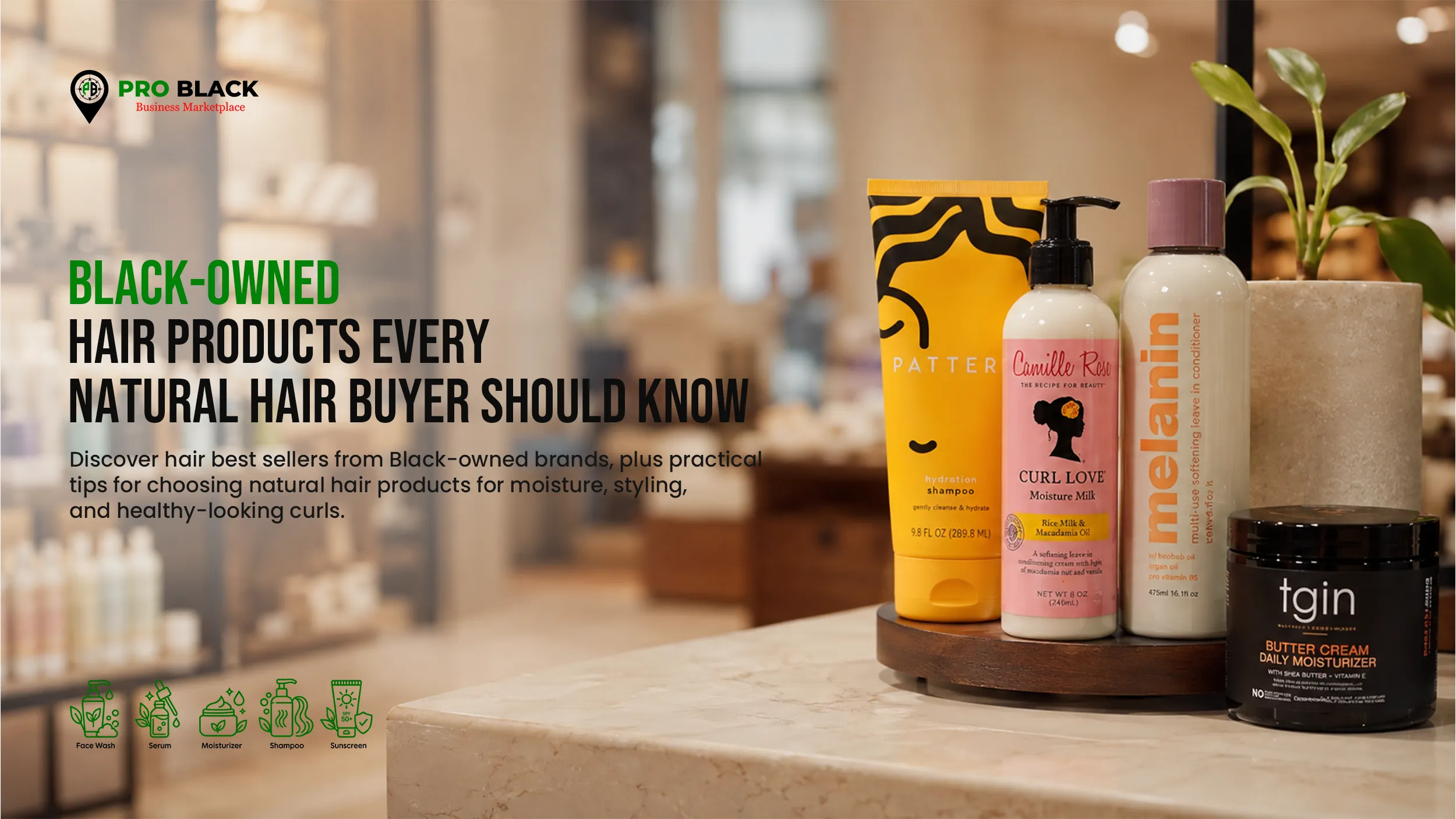
If beauty broke the mold, haircare rebuilt it entirely. Curl-specific formulas, protective styling products, scalp treatments for locs and braids, and edge control became their own booming subcategory almost overnight. Founders who grew up wrestling with products that weren't built for coily or kinky textures translated that lived experience into formulas that finally worked and the demand proved it wasn't a niche need, it was a massive underserved market.
Look for lines built around curl definition, moisture retention, protein balance, and heat protection, many of which use natural oils like castor, jojoba, and shea as base ingredients rather than the drying sulfates that dominated shelves for decades.
Fashion and Accessories
From streetwear labels that started as a single silk-screened design sold out of a trunk, to size-inclusive activewear lines and handmade jewelry using African-inspired beadwork, fashion is one of the most visually expressive corners of the movement. What ties this category together isn't one aesthetic, it's storytelling. Many pieces carry cultural references, ancestral patterns, or personal narratives baked directly into the design, turning a t-shirt or a set of earrings into something with meaning beyond the price tag.
Home and Lifestyle
Candles, ceramics, throw pillows, wall art, and small-batch home fragrance have exploded as a category, partly because they photograph beautifully for social media and partly because they let shoppers bring intention into everyday spaces. A hand-poured soy candle from a Black-owned studio or a set of mugs from an independent ceramicist does double duty: it's a beautiful object and a small act of support every time it's used.
Food and Beverage
From heritage hot sauce recipes passed down through generations to small-batch coffee roasters, wine labels, and bakeries turned into nationwide shipping operations, food tells some of the most personal stories in this whole movement. Supporting a Black-owned food brand often means tasting a recipe that's been refined in a family kitchen for decades before it ever reached a shelf.
Health, Wellness, and Self-Care
Bath soaks, herbal teas, supplements, and mental-wellness journals rounded out by Black-owned brands often center holistic approaches, sometimes drawing on herbal traditions passed through generations. This category has grown alongside broader wellness culture, but with an added emphasis on culturally specific self-care acknowledging, for instance, the unique stress of navigating systemic inequities and building products that speak directly to that experience.
Kids, Baby, and Family Products
Dolls that reflect a child's own skin tone, board books centering Black characters and history, and hair products formulated for babies' delicate curls fill a gap that mainstream retailers left open for far too long. Parents who grew up without toys or books that looked like them are especially motivated to make sure their own kids don't have that same experience and the market has responded.
Tech, Stationery, and Business Tools
Planners designed around goal-setting frameworks built by Black entrepreneurs, greeting cards celebrating culturally specific milestones, and even software tools built by Black-owned startups round out a category that's less visible but growing steadily, particularly as more consumers extend their support beyond physical goods.
Where the Keyword Really Lives: Making "Black Owned Products" Part of Your Shopping Vocabulary
At this point it's worth pausing on the phrase itself. Black owned products aren't just a marketing label it's become a functional search term, a filter option on major retail sites, and shorthand for an entire values-based approach to spending. When you type "black owned products" into a search bar, you're not just looking for an item; you're looking for a relationship between your money and a specific kind of impact. That's part of why the phrase shows up everywhere from Pinterest boards to gift guides to TikTok captions; it does more work than a plain product description ever could.
Understanding that distinction changes how you shop. Instead of searching generically for "hand cream" or "throw blanket," adding "black owned" to the query filters your results toward founders and companies with a specific ownership structure and, often, a specific story. Retailers have picked up on this behavior too, which is why so many now offer a dedicated black owned products tab, badge, or filter at checkout. If you take away one practical tip from this guide, it's this: make the phrase part of your default search habit, not just a one-time lookup around a heritage month or holiday sale.
A Closer Look at Each Category
It's one thing to list categories; it's another to understand what actually separates a standout black owned product from the rest of the shelf. Here's a deeper dive into what to look for in each space.
Beauty and Cosmetics, Revisited
The best Black-owned beauty brands tend to share a few traits: formulas tested extensively on deeper skin tones (not added as an afterthought), packaging that photographs true-to-color rather than washed out, and marketing that centers real customers rather than airbrushed ideals. When shopping in this category, pay attention to whether a brand publishes its full ingredient list openly, whether it offers a shade-matching tool or quiz, and whether return policies account for the reality that shade matching online is genuinely difficult. A brand that makes it easy to exchange a mismatched shade is signaling confidence in its product and respect for its customer.
Haircare, Revisited
Because textured hair care spans such a wide range of curl and coil patterns, no single product line works for everyone. Look for brands that are specific about which hair types their formulas are designed for, and that explain the why behind their ingredient choices for example, why a particular oil blend targets moisture retention for low-porosity hair, or why a certain protein treatment is formulated for chemically processed strands. Brands built by founders who lived the exact problem they're solving tend to be the most detailed and credible on this front, because they're not guessing they're solving something they personally struggled to find on store shelves.
Fashion and Accessories, Revisited
Beyond aesthetics, pay attention to sizing inclusivity, fabric sourcing, and production practices. Many independent Black-owned fashion labels operate on a made-to-order or small-batch model, which reduces overproduction waste but also means longer shipping windows worth knowing before you order for a specific event. Jewelry and accessory makers in particular often incorporate cultural symbolism intentionally, so if a piece catches your eye, take a moment to read the product description; you may find there's a story behind the design that adds meaning to wearing it.
Home and Lifestyle, Revisited
This category rewards patience and curiosity. Small-batch candle makers, potters, and textile artists frequently sell through their own websites or curated marketplaces rather than big-box retail, meaning some of the best finds require a bit of searching. The payoff is often a genuinely unique piece a hand-thrown mug with slight variations from batch to batch, a candle scent blended in small runs that mass-produced home goods simply can't replicate.
Food and Beverage, Revisited
Because food products carry additional regulatory and shelf-life considerations, look for clear labeling around allergens, sourcing, and expiration. Many founders in this space started by selling at farmers markets or through word-of-mouth before scaling to national shipping, and that origin story is often reflected in recipes that prioritize flavor and authenticity over mass-market blandness. If you're new to a brand's hot sauce, spice blend, or baked goods, starter or sampler sizes are a smart, low-risk way to find your favorites before committing to a larger order.
Health, Wellness, and Self-Care, Revisited
This is a category where transparency matters most. Supplements and wellness products should clearly disclose ingredients, sourcing, and any relevant certifications, especially since this space isn't as tightly regulated as pharmaceuticals. Look for brands that are upfront about what their products can and can't do, rather than making sweeping claims, a strong signal of a founder who's building for the long term rather than chasing a quick trend.
Kids, Baby, and Family Products, Revisited
Safety standards matter enormously here. Look for compliance with relevant safety certifications for toys and children's items, and check that hair and skin products for babies are formulated without harsh sulfates or fragrances that can irritate sensitive skin. Many parents who founded brands in this space did so directly because they couldn't find products that met both their safety standards and their desire for their children to see themselves represented a combination that's now widely available thanks to their effort.
Tech, Stationery, and Business Tools, Revisited
Digital products and tools built by Black-owned companies increasingly compete directly with established players on functionality, not just mission. When evaluating a planner, app, or software tool, judge it the same way you'd judge any purchase in that category: does it actually solve your problem well? The best products in this space pass that bar easily, and supporting them has the added benefit of helping diversify an industry that has historically lacked representation in leadership and ownership.
How to Verify a Product Is Actually Black-Owned
As the category has grown, so has the temptation for companies to slap on a label without the substance behind it, a practice sometimes called "diversity-washing." Here's how to shop with confidence.
Check the About" or "Our Story page. Legitimate Black-owned brands are almost always proud to share their founder's story, often with photos, background, and the "why" behind the business. Vague or missing founder information is a red flag.
Look for third-party certification. Organizations exist specifically to verify and certify Black-owned businesses, often requiring documentation of majority ownership (usually 51% or more) before a brand can display their badge. If a retailer's black owned products section references a certifying body, that's a good sign of due diligence.
Use dedicated directories and apps. Several apps and websites exist purely to catalog verified Black-owned businesses by category and location, letting you browse with confidence rather than guessing.
Read reviews for founder mentions. Genuine customers often mention the founder by name or reference a personal interaction, especially with smaller businesses a strong organic signal that the ownership claim is real.
Be wary of vague packaging claims. A product that leans heavily on visual cues (specific color palettes, cultural imagery) without any accompanying founder story or ownership information deserves a second look before you assume it's Black-owned.
When in doubt, ask. Small businesses in particular are usually happy to answer a direct message asking about ownership. It's a completely normal question in this space, and most founders welcome the chance to share their story.
The Economic Ripple Effect of Choosing Black Owned Products
It's worth zooming out to understand exactly what happens when a purchase flows toward a Black-owned business, because the impact travels further than a single transaction.
Job creation stays local. Small Black-owned businesses are more likely to hire within their own communities, meaning your purchase often supports employment close to home rather than a distant corporate headquarters.
Wealth compounds differently. Revenue from a small business owner frequently gets reinvested into the business itself, into family, or into the surrounding neighborhood a cycle that, repeated enough times, chips away at generational wealth gaps built by decades of exclusionary lending and housing policy.
Representation shapes the next generation of founders. Every successful Black-owned brand that scales becomes proof of concept for the next entrepreneur, and often a literal mentor or investor once they've built enough capital to pay it forward.
Category innovation benefits everyone. As mentioned earlier, expanded shade ranges and curl-specific formulas didn't just serve Black consumers, they raised the bar industry-wide, ultimately giving all shoppers more choices and better-formulated products.
None of this means every purchase needs to carry the weight of solving systemic inequity single-handedly. But understanding the ripple effect can turn an occasional purchase into a genuine habit.
Smart Shopping Strategies (Not Just Feel-Good Shopping)
Supporting black owned products shouldn't mean lowering your standards. The best brands in this space compete and win on quality alone. Here's how to shop smart, not just sentimentally.
Start with a need, not a novelty. Rather than buying a random item just because it's Black-owned, look for a brand that solves a problem you already have a moisturizer for your specific skin type, a planner that matches how you actually organize your day. Products you'll genuinely use are the ones that turn into repeat support.
Read ingredient lists and materials, not just marketing copy. Founders in this space are often meticulous about formulation and sourcing, precisely because they built the product to solve a gap they personally experienced. Take advantage of that transparency by actually reading labels.
Buy small first. Before committing to a full-size or subscription purchase, try a travel size, a single item, or a sample set when available. This protects your wallet while still directing dollars toward the brand.
Watch for founder-led sales events. Many small Black-owned brands run limited restocks or flash sales tied to specific dates. Following a brand's social accounts (rather than relying on algorithmic feeds) ensures you don't miss a restock of a popular item.
Leave detailed reviews. For small businesses, reviews are marketing, social proof, and product-development feedback all in one. A thoughtful review costs you two minutes and can meaningfully move the needle for a growing brand.
Gift with intention. Gift guides built around black owned products have become genuinely popular precisely because they solve a real problem: finding something thoughtful that also carries meaning. Consider building your holiday, birthday, and celebration shopping around this category as a default, not an afterthought.
Diversify beyond the biggest names. It's easy to default to the handful of Black-owned brands that have achieved massive retail distribution. Make space in your cart for smaller, independent makers too that's often where the impact of your dollar is felt most directly.
Challenges Black-Owned Businesses Still Face
Even with growing consumer enthusiasm, it's important to shop with eyes open to the structural hurdles many of these founders navigate.
Access to capital remains uneven. Studies and reporting have repeatedly highlighted a persistent gap in the rate at which Black entrepreneurs receive traditional bank loans and venture funding compared to their white counterparts, even when business fundamentals are similar. That gap often forces founders to rely more heavily on personal savings, family support, or high-interest credit to get off the ground.
Retail shelf space is competitive and expensive. Securing placement in major retailers can require minimum order quantities and marketing spend that's simply out of reach for a bootstrapped founder, no matter how strong the product.
"Support" can be seasonal. Interest in black owned products sometimes spikes around specific calendar moments and dips the rest of the year, which creates unstable, unpredictable revenue for small businesses trying to plan inventory and staffing.
Scaling without losing quality or story is hard. Rapid growth can strain a small operation's supply chain, and founders often face pressure to compromise on the very qualities of small-batch care, personal storytelling, and community connection that made the brand resonate in the first place.
Knowing these challenges doesn't mean you need to fix them personally, but it does add context to why consistent, year-round support (not just a seasonal spike) makes a measurable difference.
Beyond Purchasing: Other Ways to Support
Buying black owned products is a meaningful action, but it's not the only lever available to you.
Share and tag. A genuine social media post tagging a small business can put a product in front of thousands of new potential customers at zero cost to you.
Leave reviews across platforms, not just the brand's own website third-party review sites and marketplaces carry significant weight in a shopper's decision-making.
Refer directly. Personal recommendations to friends and family remain one of the most powerful (and underrated) growth tools for small businesses.
Volunteer skills, not just dollars. If you have expertise in photography, accounting, web design, or logistics, many small founders would welcome pro bono or discounted help far more than another one-time sale.
Advocate for structural change. Supporting local policies around small-business lending, mentorship programs, and incubators addresses the root causes behind some of the challenges outlined above.
What's Trending Right Now in the Black Owned Products Space
A few patterns stand out in the current wave of interest:
Clean, multi-use beauty Shoppers are gravitating toward Black-owned skincare and cosmetics brands built around simplified routines: a tinted moisturizer that replaces three products, a balm that works as lip color and cheek tint. Efficiency and quality are winning over sprawling product lines.
Curl and texture innovation continues. Even with the category now well established, new formulas targeting specific concerns heat damage repair, scalp health for protective styles, and lightweight definition products for finer curl patterns keep emerging and finding audiences.
Subscription and membership models. Coffee, tea, snack, and beauty subscription boxes curated entirely around black owned products let shoppers discover new brands automatically each month, which has proven especially effective for smaller makers who couldn't otherwise afford customer-acquisition costs.
Collaborative retail spaces. Pop-up shops and multi-brand storefronts both physical and digital that exclusively feature Black-owned makers are growing, giving smaller founders shared marketing power and reduced overhead compared to going it alone.
Wellness with cultural specificity. Journals, teas, and self-care products explicitly designed around the lived experience of Black consumers (rather than generic wellness messaging) are resonating strongly, particularly among younger shoppers who prioritize brands that "get it" without lengthy explanation.
Building a Sustainable Shopping Habit
The biggest risk to this movement's long-term impact isn't a lack of interest, it's inconsistency. A single viral moment or heritage-month spotlight can drive a huge spike in sales for a handful of brands, only for demand to disappear just as quickly. Here's how to build habits that last.
Set a recurring reminder, not just a seasonal one. Instead of only prioritizing black owned products around a specific month or holiday, build it into your regular shopping cadence grocery runs, gift shopping, self-care restocks all year.
Build a rotating "go-to" list. Identify a handful of Black-owned brands across categories you shop regularly (coffee, skincare, home goods) so that reaching for them becomes second nature rather than a special research project each time.
Follow founders directly. Algorithm-driven feeds don't guarantee you'll see every post from a small brand. Turning on notifications or joining an email list ensures you don't miss restocks, new launches, or sales.
Talk about it normally. Recommending a favorite black owned product to a friend the same way you'd recommend any other favorite product keeps the conversation organic rather than performative.
Track your own impact, loosely. You don't need a spreadsheet, but noticing over a year how much of your spending flows toward Black-owned businesses can be a surprisingly motivating exercise, and can help you spot categories where you have room to diversify further.
Building Your Own Black Owned Products Directory
One of the most practical things you can do after reading this guide is build a personal, running list of favorite finds, essentially your own mini-directory of black owned products organized by category. Here's a simple framework:
Beauty & Skincare: Note your go-to foundation, moisturizer, and one product you're still searching for a Black-owned alternative to.
Haircare: Track which products work for wash day, styling, and protective looks, plus one you want to try next.
Fashion: Bookmark two or three labels whose aesthetic and sizing consistently work for you.
Home: Keep a running wishlist of candle, ceramic, or textile makers you've discovered through social media or gift guides.
Food & Beverage: Save your favorite pantry staples hot sauce, coffee, tea so restocking becomes automatic rather than something you have to relearn each time.
Wellness: Note journals, teas, or self-care products that fit your routine.
Gifting: Maintain a running list of unique finds specifically earmarked for birthdays, holidays, and celebrations, so you're never scrambling last-minute.
This kind of simple, low-effort system does more for long-term impact than any single big purchase, because it turns intentional shopping into a default habit rather than something you have to consciously re-decide every time you open your wallet.
Gifting With Purpose
Gift-giving is one of the most natural entry points into this category, because gifts are already meant to carry extra thought and meaning. A candle, a skincare set, or a piece of jewelry from a Black-owned maker often comes with a story worth sharing alongside the gift itself which makes it more memorable than a generic mass-market alternative.
A few gifting tips specific to this space:
Order early for small-batch items. Because many of these products are handmade or made-to-order, shipping windows can be longer than what you'd expect from a major retailer, especially around high-demand seasons.
Bundle across categories. A themed gift box a candle, a mug, and a bag of coffee, all from different Black-owned makers creates a more memorable experience than a single item, and spreads your support across multiple small businesses at once.
Include the story. When gifting, a short note about the maker or the brand's background adds meaning that a receipt never could, and often introduces the recipient to a new brand they'll return to on their own.
Don't limit it to one season. Birthdays, housewarmings, congratulations, and "just because" moments are all opportunities to make this category your default gifting instinct rather than reserving it for a single holiday stretch.
The Global Picture
While much of the conversation in the United States centers on Black-owned businesses navigating a specific historical and economic backdrop, the broader movement toward supporting Black entrepreneurship spans continents. Diaspora-owned brands in the UK, Canada, and across the Caribbean have built their own thriving ecosystems of black owned products, often blending regional traditions West African textiles, Caribbean spice blends, Afro-European beauty formulations into products that carry distinct cultural fingerprints. And across the African continent itself, a fast-growing generation of entrepreneurs is building beauty, fashion, and food brands that are increasingly finding international audiences through e-commerce and social media, without needing a distributor or storefront in another country to reach global shoppers.
For anyone building an intentional shopping habit, it's worth looking beyond a single country's directory and exploring this wider, global landscape you'll often find products, flavors, and design traditions you simply won't encounter shopping locally alone.
Common Myths, Debunked
Black-owned products cost more: Pricing varies just as widely in this category as any other small-batch and handmade goods often carry a premium regardless of ownership, while many Black-owned brands are directly price-competitive with mainstream alternatives.
It's only relevant during specific months: While cultural heritage months often bring a welcome spotlight, treating support as a one-month event undercuts the entire economic premise of the movement, which depends on sustained, year-round demand.
Smaller brands mean lower quality : Many of the most innovative product formulations and designs in beauty, food, and home goods over the past decade have come directly from smaller, founder-led Black-owned companies not despite their size, but often because of the direct, hands-on attention that scale sometimes erodes.
You have to overhaul your entire shopping list at once Meaningful support can start with a single swap your next candle, your next lip balm, your next coffee bag rather than requiring an all-or-nothing lifestyle change.
A Simple 30-Day Challenge
If you're not sure where to start, try this: for the next 30 days, commit to making at least one purchase decision each week with black owned products specifically in mind. It doesn't need to be a large purchase: a coffee restock, a new lip product, a birthday card. The goal isn't to overhaul your entire budget overnight; it's to build the muscle of pausing before a routine purchase and asking whether there's a Black-owned alternative worth trying.
Week 1: Swap one beauty or personal care item you're about to repurchase anyway.
Week 2: Explore the food and beverage category and try a new hot sauce, coffee, or snack brand.
Week 3: Look at home goods, a candle, a mug, or a piece of wall art for a space you walk past every day.
Week 4: Handle an upcoming gift (birthday, thank-you, celebration) entirely through Black-owned makers.
By the end of the month, you'll likely have discovered at least two or three new go-to brands and the habit of checking will start to feel automatic rather than effortful. That's really the whole goal: not a single grand gesture, but a shift in the default setting of how
A Note on Language and Labels
You'll see this category referred to a few different ways "Black-owned," "Black-founded," "minority-owned" (a broader umbrella that includes but isn't limited to Black ownership), and occasionally "diaspora-owned" for brands built by members of the global Black diaspora outside a specific home country. These terms aren't perfectly interchangeable, so it's worth reading a brand's own description of itself rather than assuming based on a single label. A "Black-founded" company, for instance, may have since brought on investors or partners who aren't Black, which is worth knowing if ownership percentage specifically matters to you. Most transparent brands will clarify this directly, and it's always fair to ask if it isn't obvious.
Final Thoughts
Shopping isn't just a transaction anymore for a growing number of people, it's an extension of their values. The rise of black owned products as a category reflects something bigger than a marketing trend: it's a recognition that where money flows matters, that representation in product design isn't a bonus feature but a baseline expectation, and that supporting entrepreneurship in historically underserved communities is one small, repeatable action within reach of nearly every shopper.
You don't need to overhaul your life to participate meaningfully. Start with one category you already shop for beauty, home, food, fashion find a founder whose story and product genuinely resonate with you, and make that swap. Then do it again next month. Multiplied across millions of shoppers making the same small, intentional choices, that's how a movement becomes lasting economic change rather than a passing headline.
Frequently Asked Questions (FAQs)
Frequently Asked Questions
Q: What does "Black-owned" actually mean in terms of business ownership?
A: Check the brand's "About" or founder story page, look for third-party certification badges, browse verified directories, and don't hesitate to message the company directly and ask.
Q: Are black owned products more expensive than mainstream alternatives?
A: Not inherently. Pricing depends on factors like ingredients, production scale, and positioning the same variables that affect pricing across any brand, regardless of ownership.
Q: Is supporting black owned products only relevant during specific times of the year?
A: No. While cultural observances often bring extra visibility, sustained year-round support has a far greater long-term economic impact than concentrated seasonal spikes.
Q: What are the easiest categories to start with if I'm new to shopping this way?
A: Beauty, skincare, and food/beverage tend to have the widest selection and easiest entry points, since they're consumable, easy to try in small sizes, and widely available through both direct-to-consumer sites and major retailers.
Q: Do major retailers actually carry verified black owned products?
A: Many large retailers now have dedicated sections, filters, or badges specifically highlighting verified Black-owned brands, often in partnership with certification organizations.
Q: How do I find black owned products near me versus shopping online?
A: Local business directories, farmers markets, and community pop-up events are great starting points for in-person discovery, while dedicated apps and websites make it easy to filter and shop online by category.
Q: Can I support Black-owned businesses without spending money?
A: Absolutely. Sharing on social media, leaving detailed reviews, referring friends, and offering professional skills (design, accounting, marketing) are all valuable, no-cost ways to help a business grow.