Table of Content
Quick Answer
If you own a Pixel 10, the Pixel 11 is not a must-have upgrade. The Tensor G6 brings modest CPU gains, a big leap in on-device AI, better efficiency, and camera improvements, but the everyday experience is similar. If you are coming from a Pixel 9 or older, the Pixel 11 is a significant upgrade that is well worth it.
What Is New in the Pixel 11?
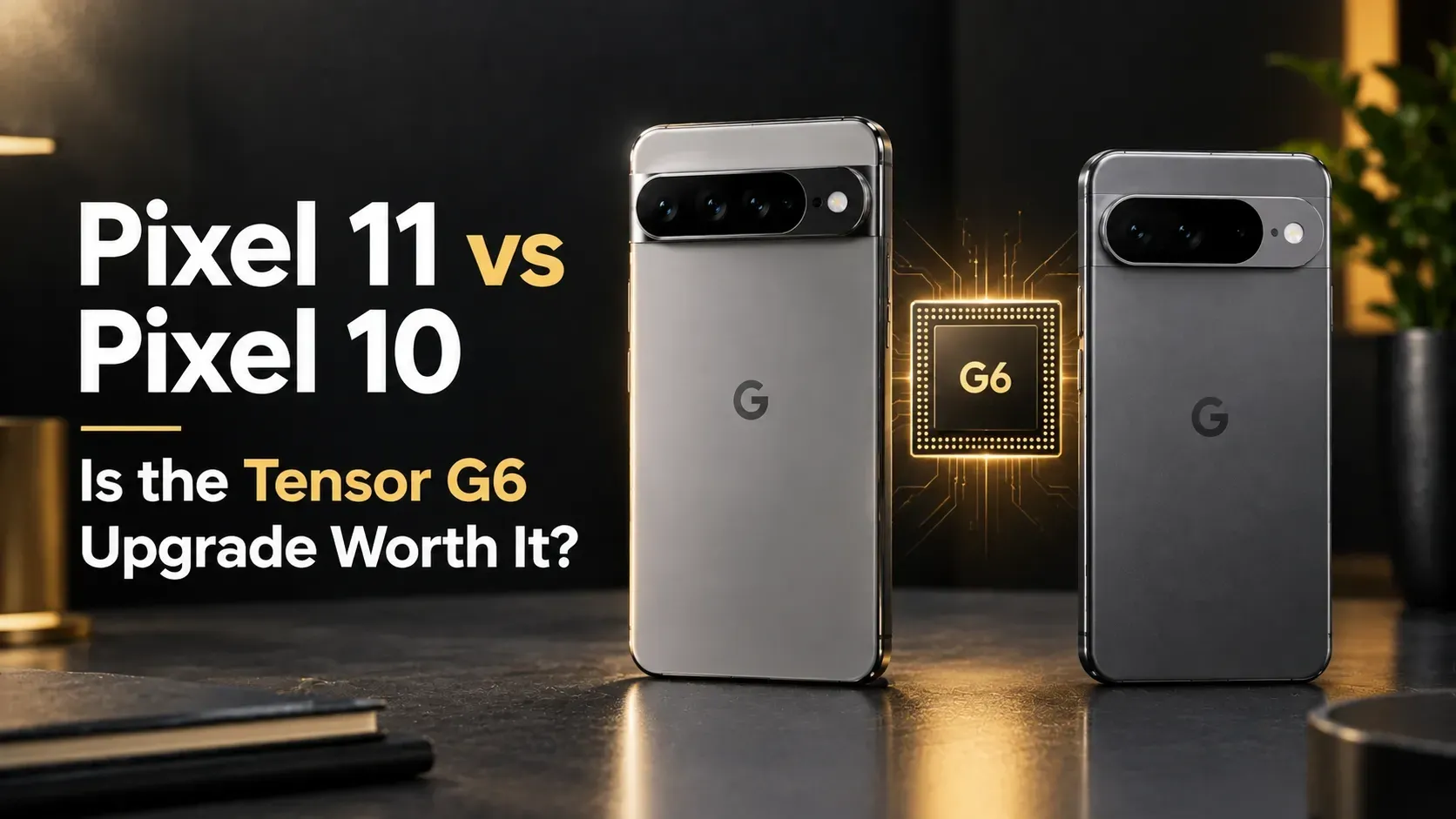
The Pixel 11, announced at Made by Google 2026 on August 12, represents Google's continued push toward AI-first computing. The design language stays familiar, but the internal upgrades are meaningful. The headline feature is the Tensor G6 chip, which brings improved CPU and GPU performance, a far more powerful TPU for on-device AI, and better power efficiency.
Beyond the chip, the Pixel 11 pairs a larger main camera sensor with improved computational photography and a host of new Gemini-powered features. Base storage has doubled to 256GB, and the starting price rose by $100 to $899.
By the numbers
$100: the price increase from Pixel 10 to Pixel 11, but base storage doubled from 128GB to 256GB at the same time.
Tensor G6 vs Tensor G5: Performance Deep Dive
The Tensor G6 moves to TSMC's 2nm (N2) process, a full node ahead of the Tensor G5's 3nm (N3E). That shift is the foundation for Google's efficiency gains: the company cites up to 20% higher CPU energy efficiency on the G6 compared with the G5.
In independent benchmarks, the G6 posts roughly 16-18% higher CPU scores in Geekbench and around 31% higher AnTuTu totals than the G5. GPU gains are more modest, noticeable in gaming but not transformative. The real story is AI: the G6 ships with a new TPU that Google says delivers 50% more compute and 2x the memory bandwidth, and in testing it decodes on-device AI models more than twice as fast as the G5.
Because the 2nm process does more work per watt, that performance does not come at the cost of battery. Combined with a similar battery capacity, the Pixel 11 generally runs a bit longer on a charge than the Pixel 10 despite the more capable hardware.
Camera Upgrades: Bigger Sensor, Better Photos
The Pixel 11's main camera uses a physically larger sensor than the Pixel 10's. More light capture means better low-light performance and improved dynamic range. The 48MP resolution stays the same, but the bigger sensor means better detail and less noise in challenging conditions.
On the Pro models, the periscope telephoto now reaches up to 120x with Google's Pro Zoom and improved AI processing, and the front camera steps up to 42MP for sharper selfies and video calls. The base Pixel 11 keeps its 10.8MP 5x telephoto and 10.5MP selfie camera.
New AI-powered camera features lean on the stronger TPU for faster processing and cleaner low-light results, with Night Sight producing brighter photos with less noise.
Software and AI Features
Both phones ship with the latest Android and 7 years of software updates. The Pixel 11's more powerful TPU, however, makes on-device AI faster and more capable: Gemini Nano runs more efficiently, real-time translation has lower latency, and photo processing is nearly instantaneous. The gap shows up most in the AI features Google keeps adding over the Pixel's long update window.
Should You Upgrade from Pixel 10 to Pixel 11?
Upgrade if
You are coming from a Pixel 9 or older. The jump to Tensor G6, the larger camera sensor, the much faster on-device AI, and the extra years of software support make the Pixel 11 a worthwhile upgrade.
Skip the upgrade if
You already own a Pixel 10. The improvements are incremental rather than revolutionary, and the Pixel 10 remains a capable phone with years of software support left.
Frequently Asked Questions
Is the Tensor G6 much faster than the G5?
In CPU benchmarks the G6 is roughly 16-18% faster (Geekbench) and about 31% higher in AnTuTu. The biggest jump is AI: a new TPU with 50% more compute and 2x memory bandwidth, and more than 2x faster on-device model decode. For everyday use, the CPU difference is modest.
Does the Pixel 11 have better battery life than the Pixel 10?
Generally yes. Thanks to the 2nm Tensor G6 and up to 20% better CPU energy efficiency, the Pixel 11 tends to last a bit longer on a charge than the Pixel 10 even though battery capacities are similar.
Is the Pixel 11 worth the $100 price increase?
For new buyers, yes. You get double the base storage (256GB vs 128GB), a larger camera sensor, and much faster on-device AI. For existing Pixel 10 owners, the upgrade is harder to justify.
The Bottom Line
The Pixel 11 is a refinement, not a revolution, but the move to a 2nm Tensor G6 makes it a meaningfully more efficient, more AI-capable phone. If you are shopping for a new Pixel, the Pixel 11 is the obvious choice. If you already own a Pixel 10, enjoy your phone and wait for the next big leap.
Looking for the best Pixel 11 deal? Browse our Electronics category for Google products from verified Black-owned sellers. Want to compare models? Read our Pixel 11 vs Pixel 11 Pro vs Pro XL comparison and our Made by Google 2026 lineup recap. Interested in selling on Pro Black? Apply to become a vendor.
Ready to find the best Pixel 11 deal?
Browse the Pro Black marketplace for phones and electronics from verified Black-owned sellers, and download the app to shop on the go.