You open your bathroom cabinet and realize something familiar: most of the products you use come from the same handful of major beauty companies.
That is not necessarily a problem. But if you have ever struggled to find a foundation that actually matches, a sunscreen that does not leave an obvious cast, or hair products designed with textured hair in mind, you already understand why brand choice matters.
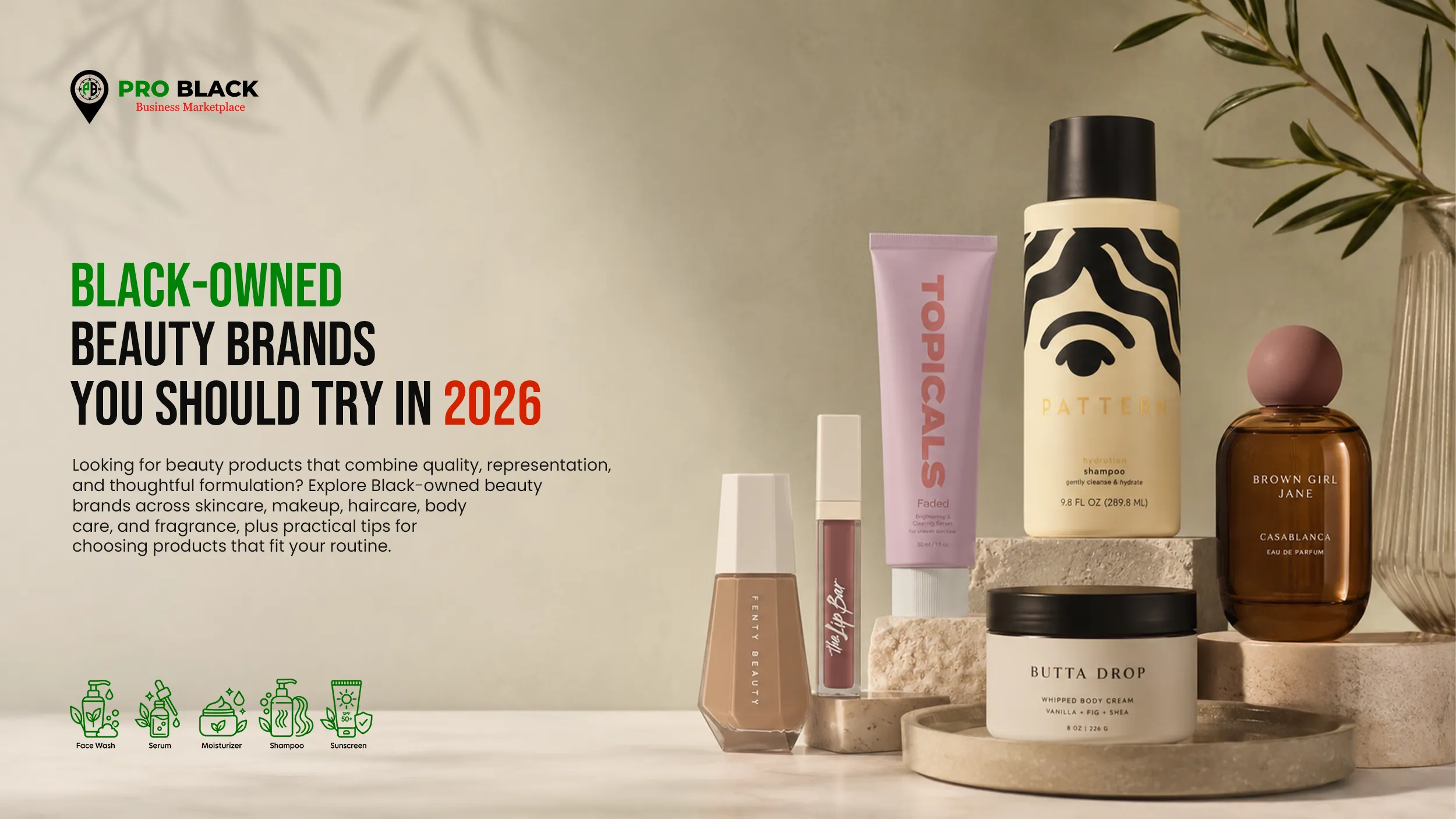
The beauty market has changed considerably. There are now Black-owned beauty companies creating skincare, makeup, haircare, fragrance, body care, and wellness products for a much broader range of consumers.
The challenge is no longer simply finding these brands. It is knowing which brands are worth exploring, what they specialize in, and how to choose products based on your actual needs rather than marketing claims.
This guide covers some of the Black-owned beauty brands worth knowing in 2026, along with practical advice for finding products that make sense for your routine.
Key Takeaways
Black-owned beauty brands now cover almost every major beauty category.
Representation matters, but ownership alone should not replace product research.
Look at ingredients, product claims, skin or hair needs, reviews, and return policies before purchasing.
Black-owned skincare brands can be especially useful for shoppers looking for products developed with melanin-rich skin in mind.
Textured hair requires different considerations than simply choosing a product labeled "natural."
Makeup shoppers should consider undertone, finish, pigmentation, and shade range.
If you want to buy black owned products, a dedicated marketplace can make discovery easier by bringing businesses and products together.
Why Black-Owned Beauty Brands Matter
The growing visibility of Black-owned beauty brands is not simply a social-media trend.
There has been a measurable mismatch between Black consumer spending and the representation of Black-owned brands in the beauty industry.
McKinsey reported that Black consumers accounted for 11.1% of U.S. beauty spending in 2021, representing approximately $6.6 billion in spending. At the same time, Black brands represented only about 2.5% of beauty-industry revenue in its analysis.
That gap helps explain why consumers may still have difficulty finding products that address specific needs.
It also explains why shoppers increasingly want to know who owns the businesses behind the products they purchase.
Representation Is Only One Part of the Equation
A Black-owned beauty company does not automatically mean every product will work for every Black consumer.
Skin tones vary.
Undertones vary.
Hair textures and porosities vary.
Skin concerns vary.
Personal preferences vary.
A good purchasing decision therefore involves two questions:
Who is behind the brand?
And:
Is this particular product right for me?
The strongest shopping approach considers both.
What Makes a Beauty Brand Worth Trying?
1. Product-Specific Formulation
Look beyond phrases such as "clean," "natural," or "made for everyone."
Check what the product actually contains and what it is designed to do.
For skincare, that might mean examining ingredients associated with hydration, exfoliation, pigmentation, or barrier support.
For haircare, consider whether the formula is designed for your hair texture, styling goal, and scalp needs.
2. Clear Shade or Texture Information
Makeup is particularly dependent on accurate product information.
A large shade range is useful, but it is not the only consideration.
Look for:
Undertone information
Finish
Coverage
Shade descriptions
Swatches on different skin tones
Wear-time information
Reviews from people with similar skin tones
3. Transparent Ownership
The phrase "Black beauty" does not necessarily mean a company is currently Black-owned.
Some brands may be Black-founded but later acquired by larger corporations.
This distinction matters if your specific goal is to support Black ownership.
McKinsey's research found that consumers often had difficulty distinguishing Black-founded brands from Black-owned brands.
For that reason, check current ownership when ownership is an important part of your purchasing decision.
4. Evidence Over Hype
Do not purchase a product simply because it is trending.
Look for detailed ingredient lists, realistic product descriptions, credible reviews, and information about how the product should be used.
The same principle applies to any beauty purchase, regardless of who owns the brand.
Black-Owned Skincare Brands to Explore
Skincare is one of the most interesting categories for Black-owned beauty companies because different brands approach melanin-rich skin from different angles.
Here are several established names worth researching.
Topicals
Topicals has become widely recognized for products targeting concerns such as hyperpigmentation and irritated skin.
The brand is particularly relevant to shoppers who want a more targeted approach rather than a basic cleanser-and-moisturizer routine.
If dark spots or uneven-looking skin are your primary concerns, investigate the specific active ingredients and usage instructions before adding a product.
Eadem
Eadem focuses on skincare designed with deeper skin tones in mind.
NBC Select lists Eadem among notable Black-owned skincare brands and describes its products as addressing concerns including dark spots, dry skin, acne scars, and related concerns.
This makes the brand worth exploring if you want skincare where consideration of melanin-rich skin is part of the product-development philosophy.
Hyper Skin
Hyper Skin is another brand associated with targeted skincare for concerns such as discoloration and blemishes.
Its approach is useful for shoppers who want products focused on specific skin concerns instead of purchasing an unnecessarily large routine.
Cay Skin
Sun protection is sometimes overlooked when discussing beauty products for deeper skin tones.
Cay Skin has built products around sun care and skincare, including formulas intended to work across skin tones. NBC Select identifies Cay Skin among Black-owned skincare brands and highlights its SPF-focused offerings.
That makes sunscreen an important category to consider when building a routine.
Black Girl Sunscreen
Black Girl Sunscreen is another recognizable name in the sun-care category.
Its popularity reflects a simple consumer problem: people want daily sunscreen without an uncomfortable or visibly noticeable finish on darker skin.
When comparing sunscreens, however, do not judge solely by branding. Check the SPF, application instructions, ingredients, water resistance where relevant, and whether the finish works for your skin.
Black-Owned Makeup Brands to Know
Makeup is where Black-owned beauty companies have had some of the most visible influence.
The important shift is not simply offering darker foundation shades. Good inclusive makeup also considers undertones, pigmentation, finish, and how products behave across different skin types.
Fenty Beauty
Fenty Beauty is one of the most recognizable names associated with the modern push for broader foundation shade representation.
Its influence on the beauty industry has also made shade inclusivity a much more visible part of mainstream beauty discussions.
For shoppers, the practical lesson is straightforward: never assume a foundation is inclusive because the brand advertises a large shade range. Always check whether the available shades actually match your undertone and depth.
Danessa Myricks Beauty
Danessa Myricks Beauty is particularly interesting for shoppers who enjoy editorial makeup, strong pigmentation, creative finishes, and versatile products.
NBC Select includes the brand among notable Black-owned makeup companies and highlights its range of face and eye products.
It is a strong option to research if your makeup routine goes beyond basic everyday coverage.
Ami Colé
Ami Colé focuses on makeup for deeper skin tones and offers products designed around a natural, skin-focused aesthetic.
This can appeal to shoppers who prefer makeup that enhances rather than completely covers the complexion.
LYS Beauty
LYS Beauty has also become a recognizable name in complexion makeup.
NBC Select identifies LYS as a Black-owned clean makeup brand and notes its focus on accessibility across skin tones and types.
For complexion products, compare undertones carefully rather than choosing a shade based only on how light or dark it appears online.
The Lip Bar
If your main interest is lip makeup, The Lip Bar is another brand worth exploring.
The company is known for colorful lip products and has expanded beyond its original makeup focus.
A lip product is also an easy way to experiment with a new brand without immediately replacing your entire beauty routine.
Black-Owned Haircare Brands for Textured Hair
Haircare is another category where product selection needs to be highly personal.
Two people can both describe their hair as curly and still require completely different products.
Hair density, curl pattern, porosity, scalp condition, styling habits, chemical treatments, and climate can all affect results.
Pattern Beauty
Pattern Beauty focuses heavily on curly, coily, and tightly textured hair.
Its product range includes cleansers, conditioners, styling products, and treatments.
The brand is especially relevant for people who want a routine built around textured hair rather than adapting products designed primarily for straight hair.
Mielle Organics
Mielle Organics is another widely recognized name in Black-owned haircare.
The brand offers products across cleansing, conditioning, styling, and scalp-care categories.
As with any haircare brand, it is better to select individual products based on your hair's needs rather than assuming an entire product line will work equally well for you.
Camille Rose
Camille Rose offers a broad range of hair and body products, including products for textured hair.
Its product selection can be useful for shoppers who enjoy richer conditioning products and ingredient-focused haircare.
Bomba Curls
Bomba Curls focuses on curly and textured hair and has roots in Dominican haircare traditions.
PETA includes Bomba Curls among Black-owned beauty companies and describes its range as including hair masks, oils, and styling products.
Its cultural perspective is also a reminder that Black beauty is not a single category. The community includes many different cultural backgrounds, hair practices, and beauty traditions.
Body Care, Fragrance, and Wellness
Black-owned beauty is much broader than foundation, moisturizer, and shampoo.
Body care and fragrance have also become increasingly diverse.
54 Thrones
54 Thrones is known for beauty and body-care products inspired by African beauty traditions.
The brand is worth researching if you are interested in body care that incorporates cultural influences rather than treating personal care as purely functional.
Hanahana Beauty
Hanahana Beauty is another brand worth exploring for body care.
Its products are associated with shea butter-based body care and Ghanaian sourcing relationships.
This category can be particularly appealing if you prefer simple, nourishing body-care products rather than complicated routines.
Fragrance Is Worth Exploring Too
Black-owned fragrance brands deserve more attention because the category has historically received less discussion than skincare and makeup.
Sephora's current Black-owned beauty collection includes brands across fragrance, haircare, skincare, makeup, and body care, demonstrating how broad the category has become.
Some names currently highlighted by Sephora include 54 Thrones, Brown Girl Jane, Harlem Perfume Co., and World of Chris Collins.
If you are building a beauty collection, fragrance can therefore be another way to support Black-owned businesses without limiting your choices to complexion or hair products.
A Simple Black-Owned Beauty Brand Comparison
Category | Brands to Explore | Best For | What to Check |
|---|---|---|---|
Skincare | Topicals, Eadem, Hyper Skin | Dark spots, hydration, targeted concerns | Actives, skin type, sensitivity |
Sunscreen | Cay Skin, Black Girl Sunscreen | Daily sun protection | SPF, finish, application |
Makeup | Fenty Beauty, Ami Colé, LYS Beauty | Complexion and everyday makeup | Shade, undertone, finish |
Artistic Makeup | Danessa Myricks Beauty | Creative and high-impact looks | Pigmentation, application |
Lip Makeup | The Lip Bar | Everyday or statement lips | Finish, wear, shade |
Textured Hair | Pattern Beauty, Mielle Organics | Curly and coily hair | Porosity, density, styling goal |
Hair & Body | Camille Rose, Bomba Curls | Conditioning and textured-hair care | Ingredients, moisture level |
Body Care | 54 Thrones, Hanahana Beauty | Body moisturization and care | Texture, fragrance, ingredients |
Fragrance | Brown Girl Jane, Harlem Perfume Co. | Personal fragrance | Notes, concentration, longevity |
The brands above are starting points, not a ranking. A product that works extremely well for one person can be completely wrong for another.
How to Choose the Right Black-Owned Beauty Product
Knowing several brands is useful.
Knowing how to choose between them is even more useful.
Step 1: Start With the Problem
Do not start with the brand.
Start with your need.
For example:
Dry skin
Dark spots
Uneven complexion
Daily sunscreen
Frizz
Dry scalp
Curl definition
Foundation matching
Long-wearing lipstick
Body moisturization
Fragrance
Once you identify the problem, the product category becomes much easier to narrow down.
Step 2: Check the Ingredients
You do not need a chemistry degree to read an ingredient list.
Look for the ingredients relevant to your objective and be cautious about products that make dramatic promises without explaining how the formula supports them.
If your skin is sensitive, introduce one new product at a time.
That makes it easier to determine what is helping or irritating your skin.
Step 3: Check Skin Tone and Undertone
This is particularly important for foundation and concealer.
Your depth describes how light or dark your skin appears.
Your undertone describes the underlying hue, commonly described as warm, cool, neutral, or olive.
Two people with similar skin depth can therefore need completely different foundation shades.
Step 4: Match Hair Products to Your Routine
Do not buy a product just because it says "curly hair."
Consider whether your goal is:
Moisture
Definition
Hold
Volume
Scalp care
Detangling
Heat protection
Protective styling
Repair
Your styling habits are often just as important as your curl pattern.
Step 5: Read Reviews Critically
Reviews are useful, but they are not absolute evidence.
Look for reviews from people with similar:
Skin tone
Skin type
Hair texture
Hair density
Product expectations
A review saying "this is amazing" tells you less than a detailed review explaining exactly how the product performed.
How to Buy Black-Owned Products Online
If your goal is to buy black owned products, you do not necessarily need to change everything you purchase overnight.
A more realistic approach is to make intentional substitutions.
Start with one category.
Maybe your next moisturizer comes from a Black-owned skincare brand.
Your next shampoo could come from a Black-owned haircare company.
The next time you need lipstick, try a Black-owned cosmetics brand.
Over time, those small decisions can become part of your normal shopping routine.
Use a Dedicated Marketplace
Finding individual brands can mean opening multiple websites, comparing shipping policies, checking reviews, and creating separate accounts.
A dedicated marketplace can simplify discovery.
Pro Black's Shop gives shoppers a central place to explore products within a marketplace focused on Black-owned commerce. Pro Black says its platform includes verified businesses and allows shoppers to discover, shop, and book services.
That approach is particularly useful if you want to explore categories beyond beauty.
Verify Before You Buy
Before completing an online purchase, check:
Product description
Ingredients
Seller information
Reviews
Shipping information
Return policy
Product availability
Current ownership if Black ownership is important to you
A beautiful website is not enough.
Good shopping decisions come from useful information.
Ready to explore Black-owned products in one place? Browse the Pro Black Shop and discover products from businesses built around Black-owned commerce.
How Pro Black Can Help
Pro Black is designed as a marketplace for discovering, shopping from, and connecting with Black-owned businesses.
The platform says its business listings are reviewed before going live and combines product shopping with business and service discovery.
For shoppers, that can make the discovery process more straightforward.
Instead of relying entirely on social media or searching through unrelated websites, you can explore businesses and products through a platform specifically built around Black-owned commerce.
Pro Black also provides a directory for discovering Black-owned businesses by state and city, which can be useful when you want to support businesses beyond online shopping.
Looking for more than beauty products? Explore Pro Black to discover Black-owned businesses, products, and services across different categories.
How to Build a Better Black-Owned Beauty Routine
You do not need a completely new beauty cabinet.
A practical approach is to replace products gradually.
Start With Your Everyday Essentials
Identify the products you purchase repeatedly.
For example:
Cleanser
Moisturizer
Sunscreen
Shampoo
Conditioner
Styling product
Foundation
Lip product
Then research Black-owned alternatives in those categories.
Choose Quality First, Then Brand Fit
Supporting Black-owned businesses and choosing high-quality products are not competing goals.
You can do both.
Look for brands that provide transparent information, products appropriate for your needs, and a shopping experience you trust.
Keep Your Routine Simple
More products do not necessarily mean better results.
A simple routine that you consistently use is often more practical than a shelf full of products you rarely finish.
Why Buying Black-Owned Beauty Products Is Becoming Easier
The biggest difference today is visibility.
Major retailers now maintain dedicated collections of Black-owned beauty brands.
For example, Sephora currently features a dedicated Black-owned beauty collection spanning makeup, skincare, haircare, fragrance, and wellness-related categories.
Editorial publications are also regularly highlighting emerging brands.
Byrdie reported on emerging Black-owned beauty and wellness brands across categories including skincare, makeup, haircare, fragrance, and personal wellness in 2026.
This wider visibility gives consumers more opportunities to compare products rather than settling for whatever happens to be available locally.
It also creates more room for smaller brands to build recognition based on the quality and usefulness of their products.
What Should You Try First?
If you are completely new to Black-owned beauty brands, do not make the process complicated.
Choose one category that matters to you.
For skincare: Start by identifying your biggest concern, such as dryness, dark spots, or sensitivity.
For makeup: Begin with a product that is easy to match, such as lipstick or blush, before tackling foundation.
For haircare: Identify whether your priority is moisture, definition, hold, scalp care, or repair.
For body care: Look for a moisturizer, body butter, scrub, or fragrance that fits your preferences.
For fragrance: Start with scent families you already enjoy instead of buying based only on the brand name.
The goal is not to buy the largest number of Black-owned products.
The goal is to discover products and businesses that genuinely deserve a place in your routine.
Conclusion
Black-owned beauty brands have become an important part of the modern beauty market, with options spanning skincare, makeup, textured-hair care, body care, fragrance, and wellness.
But good shopping requires more than choosing a brand because it has a compelling story.
Look at the formula.
Consider your skin or hair needs.
Check the shade or texture.
Read reviews carefully.
And, when ownership matters to you, verify the company's current ownership rather than assuming that "Black-founded" and "Black-owned" mean the same thing.
If you want to buy black owned products, start small. Replace one everyday product, see how it performs, and build from there.
That approach makes supporting Black-owned beauty businesses practical, sustainable, and part of your regular shopping habits rather than something you do only on special occasions.
3. FAQ Section
Frequently Asked Questions
1. What are the best Black-owned beauty brands to try?
Some well-known brands to research include Topicals, Eadem, Cay Skin, Danessa Myricks Beauty, Ami Colé, LYS Beauty, Pattern Beauty, Mielle Organics, Camille Rose, and 54 Thrones. The best choice depends on your specific skincare, makeup, haircare, or body-care needs.
2. How can I tell if a beauty brand is Black-owned?
Check the company's current ownership information rather than relying only on its founder story. A Black-founded company may not necessarily remain Black-owned after acquisition or changes in ownership.
3. Are Black-owned beauty products only for Black consumers?
No. Many Black-owned beauty brands create products that can be used by people across different skin tones, hair textures, and backgrounds. However, some products are specifically developed around needs that have historically been underserved, such as melanin-rich skin and textured hair.
4. Where can I buy Black-owned beauty products online?
You can shop directly from individual brand websites, major retailers with dedicated Black-owned collections, and marketplaces such as Pro Black. Sephora, for example, maintains a dedicated collection of Black-owned beauty brands across multiple categories.
5. Are Black-owned beauty brands more suitable for darker skin?
Not automatically. Some brands specifically develop products for melanin-rich skin, but suitability still depends on your individual skin type, undertone, concerns, and preferences.
6. What should I look for when buying Black-owned skincare?
Check the ingredients, intended skin concerns, product instructions, reviews, potential sensitivities, and return policy. Do not choose a skincare product solely because it is marketed toward a particular demographic.
7. Why should consumers support Black-owned beauty businesses?
Supporting Black-owned businesses can help increase visibility and customer revenue for companies that remain underrepresented in the broader beauty market. McKinsey's research found a substantial gap between Black consumer beauty spending and the revenue share captured by Black brands.