Table of Content
Introduction
For a few years, corporate America wore diversity, equity, and inclusion like a badge. Brand statements went out after every headline event. Retailers built "Black-owned" endcaps in aisle six. Marketing decks were full of representation language, hiring targets, and supplier-diversity pledges. Then, starting around 2023 and accelerating through 2024 and 2025, a lot of that infrastructure quietly disappeared. Companies rebranded DEI departments, folded diversity budgets into generic "belonging" line items, or cut the programs outright, often citing legal risk, shareholder pressure, or simple cost-cutting.
What's interesting is what didn't disappear along with it: the businesses. Black-owned brands that had built real products, real customer relationships, and real supply chains during the DEI era didn't need the DEI era to keep going. Some of them are doing better now than they were when the corporate spotlight was on them, because they were forced to build direct relationships with customers instead of relying on a retailer's diversity initiative to keep them on the shelf.
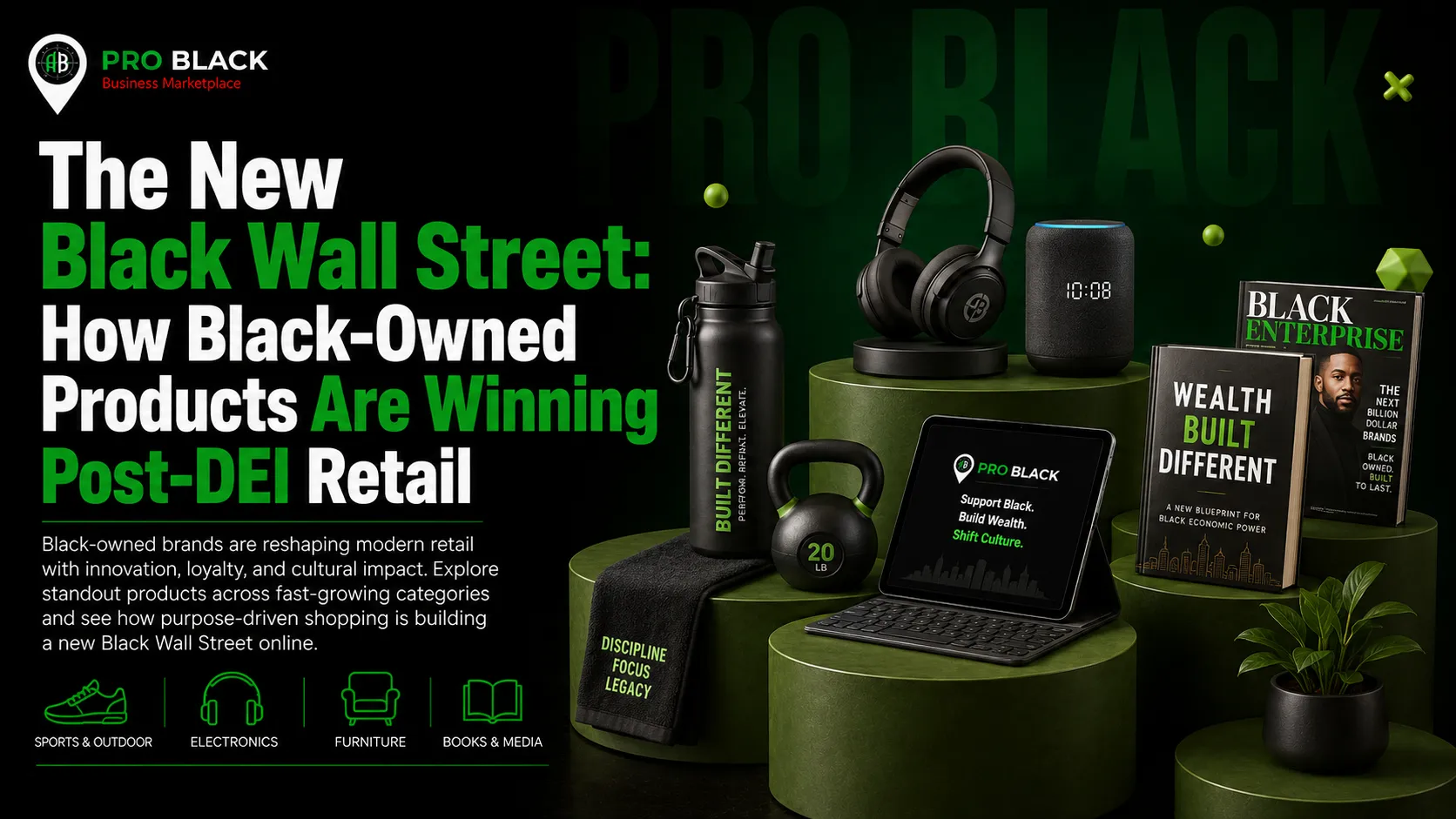
This is the story of what's sometimes being called "the new Black Wall Street" not a physical district this time, but a distributed, digitally connected economy of entrepreneurs, manufacturers, and retailers who are proving that Black-owned products can win on their own terms, without a corporate mandate propping them up. It's a story about resilience, but it's also a story about strategy: what these businesses are doing differently, where they're finding customers now that the DEI marketing machine has gone quiet, and what the retail landscape actually looks like once the performative layer is stripped away.
This piece is not a sales pitch for any specific company. It's an attempt to look honestly at the data, the history, and the current state of the market.
A Short History Lesson: What "Black Wall Street" Actually Meant
To understand why the phrase "the new Black Wall Street" carries weight, it helps to understand the original one.
The Greenwood District of Tulsa, Oklahoma, in the early 20th century was one of the most prosperous Black communities in the United States. Because of segregation, Black residents were barred from spending their money in white-owned establishments in much of the city, so an entire self-contained economy grew inside Greenwood: grocery stores, hotels, theaters, law offices, doctors' practices, banks. Dollars circulated within the community multiple times before ever leaving it. That internal circulation money staying inside the community and recirculating is the economic principle people are pointing to when they invoke the name today.
In 1921, a white mob destroyed Greenwood over the course of about eighteen hours, killing an estimated 100 to 300 people and burning down roughly 35 city blocks. It was one of the most devastating acts of racial violence in American history, and it wiped out generations of accumulated Black wealth almost overnight.
So when people use the phrase "the new Black Wall Street" now, they are not being casual about it. They are invoking a very specific historical model: an internal economy that thrives on community reinvestment while also carrying an awareness of how fragile that kind of prosperity can be when it depends on external protection or goodwill. That history is part of why so many Black entrepreneurs today are deliberately building businesses that don't depend on a single retailer, platform, or corporate partner to survive.
What Actually Happened With DEI in Retail
It's worth being precise about what changed, because "post-DEI" gets used loosely.
Through roughly 2020 to 2023, in the wake of nationwide protests following George Floyd's murder, a wave of major retailers made public commitments to stock more products from Black-owned businesses. Target's "Black Beyond Measure" initiative, Sephora's 15 Percent Pledge commitment, Macy's supplier diversity goals, and similar programs from companies like Nordstrom, CVS, and Ulta Beauty all promised measurable shelf space, marketing support, and procurement dollars for Black-owned brands specifically.
Starting in 2023, a legal and political backlash began to reshape this landscape. The Supreme Court's ruling on affirmative action in college admissions emboldened challenges to corporate diversity programs on similar legal grounds. Conservative activists and legal groups began targeting supplier-diversity programs and DEI hiring initiatives with lawsuits and boycott campaigns. Several large companies including some retailers that had made loud 2020-era pledges scaled back or rebranded their diversity programs by 2024 and 2025, often without much public explanation.
The practical effects varied by company, but common patterns included:
Dedicated "Black-owned" or "diverse-owned" shelf sections being quietly folded back into general merchandising categories
Supplier-diversity teams being downsized, merged into procurement generally, or eliminated
Marketing campaigns that once explicitly highlighted a brand's Black ownership shifting toward more neutral language
Reduced or eliminated matching funds, grant programs, and accelerator partnerships that had funneled capital to minority-owned brands
None of this happened uniformly or all at once, and some retailers have maintained their commitments even amid the broader retreat. But the overall trend by 2025 and into 2026 has been a retail environment where the explicit, marketed emphasis on Black ownership as a purchasing rationale has diminished significantly compared to its 2020–2022 peak.
The Businesses That Are Still Standing and Growing
Here's the part that surprised a lot of retail analysts: many Black-owned brands are not just surviving this pullback, they're expanding. The reasons are worth unpacking, because they say something about what actually drives sustainable retail success versus what was, in some cases, a temporary marketing tailwind.
They built direct-to-consumer infrastructure early. Brands that used their 2020–2023 retail placement primarily as a launching pad collecting customer emails, building loyalty programs, and investing in their own e-commerce sites were far less exposed when big-box shelf space contracted. A brand that had 40% of its revenue coming through its own website and 60% through a retailer partnership could absorb a retreat in the retailer relationship. A brand that had 95% of its revenue dependent on one chain's diversity shelf was in serious trouble the moment that shelf disappeared.
They diversified retail partners instead of concentrating on flagship "diversity" placements. Some founders have talked openly about deliberately avoiding becoming "the DEI brand" for any single retailer, instead pursuing broader placement based on product performance metrics sell-through rate, repeat purchase rate, margin the same numbers any category buyer cares about regardless of ownership.
They built genuine product quality and brand loyalty, not just narrative appeal A skincare line or a snack brand that got an initial trial because of its ownership story only survives long-term if the actual product performs. The brands weathering the post-DEI period best are largely ones with strong repeat-purchase rates that were never solely dependent on the "support Black-owned" purchase motivation in the first place customers kept buying because the product worked, tasted good, or fit their life, not just because of who founded it.
They leaned into community-based and independent retail channels. Farmers markets, Black-owned grocery co-ops, independent boutiques, pop-up markets, and regional distribution through minority-owned wholesalers have all become more important as national chain relationships have cooled. This is, in a sense, a return to the Greenwood model on a modern, digitally networked scale dollars circulating through a self-reinforcing network of Black-owned suppliers, retailers, and consumers rather than depending entirely on a single large gatekeeper.
Where the Growth Is Actually Happening: Category by Category
It's useful to break this down by product category, because the dynamics differ quite a bit.
Beauty and Personal Care
Beauty has arguably been the most closely watched category, partly because of how visible the 2020-era pledges were (Sephora's 15 Percent Pledge, Ulta's Black-owned beauty initiatives) and partly because Black consumers have historically been underserved by mainstream beauty formulations and marketing. Hair care in particular brands formulating specifically for textured and curly hair built loyal customer bases well before the DEI wave and have largely retained them. Skincare brands addressing hyperpigmentation and a wider range of skin tones similarly built product-level differentiation that doesn't depend on a retailer's diversity messaging to be relevant.
Food and Beverage
This category shows some of the clearest signs of durable, non-DEI-dependent growth. Black-owned food brands sauces, snacks, beverages, baked goods that got early traction through farmers markets, regional grocery chains, and word-of-mouth have expanded distribution based on sales velocity, not ownership narrative. Regional and independent grocers, in particular, have continued to actively seek out these products because customers keep buying them.
Fashion and Apparel
Apparel has been more volatile. Streetwear and fashion brands that leaned heavily on a "buy Black" cultural moment for launch buzz have generally struggled more than brands with distinct design points of view or strong wholesale relationships built on merchandising fundamentals rather than ownership story alone.
Books, Media, and Toys
Publishers and toy makers focused on Black representation in children's media have found a durable niche audience parents actively seeking out books and toys with Black protagonists represent an ongoing market need that isn't tied to a corporate DEI cycle; it's tied to a persistent gap in mainstream offerings that existed well before 2020 and continues to exist now.
Tech and Consumer Products
This is the thinnest category in terms of Black ownership representation, and it remains one of the harder ones to break into given the capital intensity of hardware and software development. Access to venture capital for Black founders has actually declined in the post-2023 period across nearly all sectors, and tech is no exception a headwind worth naming honestly rather than glossing over.
Consumer Behavior: What's Actually Driving the Purchase Decisions Now
One of the more interesting shifts is in why people are buying Black-owned products in 2026 compared to 2020.
In the immediate aftermath of 2020, purchasing decisions were heavily influenced by a moment of social reckoning; buying Black-owned was, for many consumers, partly an act of political and moral expression tied to a specific cultural moment. That kind of purchase motivation, research on consumer behavior consistently shows, tends to be less durable than motivation rooted in product satisfaction, habit, and identity.
What's emerging now looks more sustainable, if smaller in scale: a core customer base disproportionately but not exclusively Black consumers who buy black owned products as a routine part of how they shop, not as a one-time statement purchase. This is closer to the Greenwood model of internal economic circulation than the 2020 moment was. It's less visible, less marketed, and less tied to corporate pledges, but arguably more resilient, because it doesn't require a company's PR department to keep functioning.
Surveys conducted by organizations tracking Black consumer spending have generally found that a meaningful share of Black consumers report intentionally seeking out Black-owned brands when comparable options exist, particularly in categories like beauty, food, and media where representation gaps have historically been most acute. That behavior appears to have persisted through the DEI retreat, even as the marketing apparatus that once amplified it has shrunk.
The Role of Social Media and Direct Digital Channels
If big-box retail diversity shelves were the visible symbol of the 2020–2023 era, social media and direct e-commerce are the infrastructure of the current one.
Platforms like Instagram, TikTok, and increasingly niche community platforms have become the primary discovery mechanism for many Black-owned brands, replacing the retailer endcap as the place where new customers first encounter a product. TikTok Shop in particular has become a meaningful revenue channel for smaller brands that would never have gotten national retail placement in the first place, letting them build a customer base one viral video at a time without needing a retail buyer's approval.
This shift has real advantages and real limits. On the advantage side: founders keep more margin, they own the customer relationship directly (email lists, first-party data), and they're not dependent on any single company's internal politics or legal risk tolerance. On the limit side: digital-only distribution is a much harder, slower path to scale than national retail placement, algorithm changes can tank visibility overnight, and the capital required to run effective paid social campaigns is a real barrier for founders without existing funding.
Community-specific platforms and directories sites and apps built specifically to help people find Black-owned businesses by category and location have also grown as intermediaries filling the gap left by retailers' shrinking diversity marketing. These function less like a marketing campaign and more like an ongoing yellow pages, a lower-drama, less headline-driven way of connecting buyers and sellers that doesn't depend on any single company's quarterly DEI budget.
Funding and Capital Access: The Part of the Story That Isn't Improving
It would be dishonest to write about this topic without being direct about the harder numbers. While product-level resilience among established Black-owned brands is a genuinely encouraging story, access to growth capital for Black entrepreneurs has not improved during this period. If anything, it has gotten harder.
Venture capital funding to Black-founded startups, which was already a small fraction of total VC dollars (commonly cited estimates place it under 1-2% of total U.S. venture funding in most years), declined further in the years following the 2021 peak in DEI-adjacent corporate and investment commitments. Several corporate venture funds and accelerator programs that had launched specifically to invest in Black and minority founders during 2020–2022 were quietly wound down, paused, or folded into general-purpose funds by 2024–2025.
Small business lending shows a similar pattern. Black-owned businesses have historically faced higher loan denial rates and higher interest rates than comparable white-owned businesses when applying through traditional banks, according to Federal Reserve small business credit survey data collected over multiple years. Community development financial institutions (CDFIs), Black-owned banks, and credit unions have tried to fill part of this gap, and several have reported increased deposits and loan volume as some consumers and businesses deliberately moved banking relationships to Black-owned financial institutions itself another small but real piece of the new Black Wall Street internal-circulation model.
The honest summary: product-market fit and customer loyalty are areas where Black-owned brands are demonstrating real, durable strength in the post-DEI period. Access to the kind of capital that turns a strong regional brand into a national one remains a significant, largely unresolved structural challenge.
Retail Partnerships That Have Survived and Why
Not every retailer pulled back. Some companies have maintained supplier-diversity commitments, and it's worth looking at what distinguishes them.
Retailers that built supplier-diversity programs into core procurement processes rather than as a marketing-adjacent initiative have generally been more durable, because the legal and political attacks have focused primarily on programs framed explicitly around race-conscious hiring or marketing quotas, which face more direct legal exposure post-2023 Supreme Court rulings. Programs framed instead around expanding the overall pool of qualified suppliers, with selection still ultimately based on standard business criteria, have proven somewhat more resistant to the legal challenges driving the broader retreat.
Independent and regional grocers, in particular, have continued actively seeking Black-owned food and beverage products, often citing straightforward business reasons: customer demand, product differentiation, and community relationships in specific markets, rather than any formal diversity mandate. This suggests that where the underlying business case is strong and doesn't rely on litigation-exposed program structures, the retail relationship can survive the broader corporate DEI pullback relatively intact.
Common Challenges Black-Owned Brands Still Face
It's worth being clear-eyed about what hasn't gotten easier, alongside what has proven resilient.
Shelf space is genuinely more competitive now that dedicated diversity sections have shrunk or disappeared in many chains Black-owned brands are increasingly competing head-to-head against all other brands in a category, without any placement advantage, which raises the bar on product performance and margin.
Marketing budgets remain smaller on average. Without matching funds or co-op marketing support that some retailers offered during the DEI-program era, many founders are self-funding customer acquisition, which is expensive and slower.
Supply chain and manufacturing capital constraints persist. Scaling production to meet a big retail order requires working capital that's hard to access given the lending gaps described above, and a few brands have reportedly had to turn down large retail orders because they couldn't finance the inventory needed to fulfill them.
Founder burnout and bandwidth are recurring themes in interviews with small business owners in this space; many are running lean teams while also handling marketing, fundraising, and operations simultaneously, without the kind of institutional support larger competitors take for granted.
What "Winning" Actually Looks Like in This Environment
Given all of the above, it's worth defining what success looks like for Black-owned brands in the post-DEI retail landscape, because it doesn't necessarily mean matching the scale of the largest national CPG companies.
For many founders, "winning" now looks like: sustainable, profitable growth built on repeat customers rather than one-time diversity-motivated purchases; diversified distribution across direct-to-consumer, independent retail, and select national accounts rather than dependence on a single big-box relationship; ownership retention rather than early equity dilution to chase rapid but fragile scale; and building toward long-term community wealth hiring locally, sourcing from other Black-owned suppliers, reinvesting profits regionally echoing the internal-circulation principle of the original Greenwood district more than the venture-scale growth model that dominates most retail success narratives.
This is a genuinely different model of success than "get acquired by a major conglomerate" or "IPO," and it's one that a number of founders in this space describe choosing deliberately, partly because it's more resilient to exactly the kind of external policy and corporate-sentiment swings the industry just went through.
Looking Ahead: What Could Change This Picture
A few developments worth watching:
Further legal rulings on the boundaries of permissible supplier-diversity programs could either stabilize or further erode the retail partnerships that have survived so far, depending on how courts interpret the scope of anti-discrimination law as applied to corporate procurement.
Consumer sentiment is genuinely uncertain to forecast; some analysts expect continued growth in intentional Black-owned purchasing as a stable, values-driven habit; others expect it to fade further as the cultural salience of the 2020 moment continues to recede with time.
Growth in Black-owned banking and CDFI lending capacity could meaningfully close the capital-access gap if current momentum continues, though it remains a small fraction of the overall lending market.
Continued growth of digital and social commerce channels seems likely to keep lowering the barrier to building a direct customer relationship, regardless of what happens with big-box retail policy which may make brands increasingly resilient to future swings in corporate DEI sentiment either direction.
Conclusion
The phrase "the new Black Wall Street" is doing real work when people use it to describe this moment. It's not a claim that the retail landscape has become equitable or that Black-owned businesses now enjoy the institutional support they were promised in 2020. Capital access, in particular, remains a serious unresolved problem. But it does capture something true: a meaningful number of Black-owned brands built real product quality, real customer loyalty, and real distribution diversity during the DEI era, and that foundation is proving durable now that the marketing spotlight has moved on. The businesses that are thriving in 2026 are largely the ones that were never entirely dependent on that spotlight to begin with they built something people wanted to keep buying, on its own merits, and found ways to keep reaching those customers directly when the corporate infrastructure around them changed. That's a quieter story than the 2020 moment, but it may end up being a more lasting one.
Frequently Asked Questions
What does "post-DEI retail" mean? It refers to the retail environment following the pullback of diversity, equity, and inclusion programs that many major retailers implemented after 2020. Starting around 2023–2025, legal challenges and shifting corporate priorities led many companies to scale back or eliminate dedicated supplier-diversity initiatives, diversity-focused marketing, and related budgets.
Why did retailers pull back on Black-owned business initiatives? The main drivers were legal risk following the 2023 Supreme Court affirmative action ruling, which emboldened lawsuits and legal challenges against race-conscious corporate programs, along with shareholder pressure, cost-cutting, and shifting political and cultural sentiment around DEI more broadly.
Are Black-owned businesses actually growing despite the DEI pullback? Many are, particularly brands that built strong product quality, direct-to-consumer sales channels, and diversified retail relationships during the DEI era rather than depending on a single retailer's diversity shelf. Categories like food and beverage, hair and beauty, and children's media have shown particularly durable growth.
What is the "new Black Wall Street"? It's a term used to describe a modern, digitally connected network of Black-owned businesses, consumers, and financial institutions that echoes the internal economic circulation of the original Greenwood district in Tulsa, Oklahoma dollars and customer loyalty staying within a community-connected network rather than depending on external corporate support.
Has funding for Black-owned businesses gotten better or worse? Access to venture capital and traditional small business loans for Black founders has not improved during this period and has arguably declined in some areas, even as product-level customer loyalty has proven resilient. This remains one of the most significant unresolved challenges in space.
Where are people finding Black-owned products now that retail shelf space has shrunk? Social media platforms (particularly Instagram and TikTok, including TikTok Shop), direct-to-consumer websites, community-specific business directories, farmers markets, and independent or regional grocers have become increasingly important discovery and purchase channels.
Is buying black owned products still a meaningful trend, or was it just a 2020 moment? Available consumer research suggests a core group of shoppers especially in categories like beauty, food, and media continue to intentionally seek out black owned products as a routine shopping habit rather than a one-time statement purchase, suggesting more durability than a passing cultural moment, even as the surrounding corporate marketing apparatus has diminished.
What can independent retailers or grocers do to support Black-owned brands going forward? Retailers that have maintained relationships successfully tend to base sourcing decisions on standard business criteria (sell-through, margin, customer demand, product differentiation) rather than programs structured explicitly around race-based quotas, which have proven more legally durable in the current environment while still expanding the pool of suppliers considered.