Table of Content
There was a moment, not so long ago, when the fastest way to sell out a product line was to attach it to a cause. A black square on Instagram. A pledge in a company bio. A hashtag that promised solidarity in fourteen characters or less. For a brief, intense window, "support black-owned" became a marketing category all its own, and thousands of founders rode that wave to their first sales spike, their first press mention, their first viral moment.
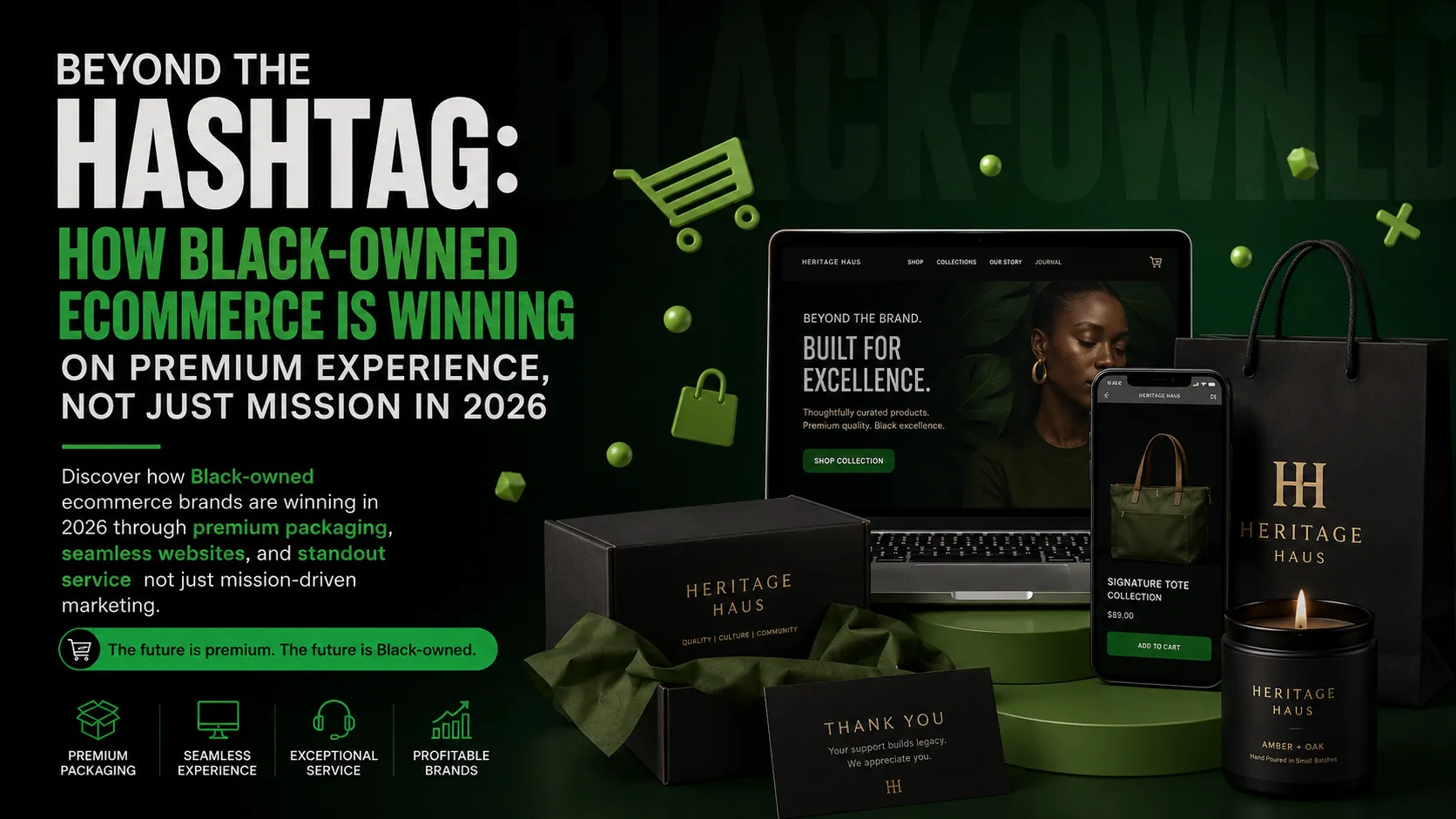
That wave has receded. What's left standing in 2026 isn't the brands that shouted the loudest about their mission it's the ones that quietly built something better. Better products. Better packaging. Better websites. Better customer service. Better everything, delivered with the kind of polish that used to be reserved for legacy luxury houses and venture-backed unicorns.
This is the real story of Black-owned ecommerce today, and it's a far more interesting one than the hashtag era ever let on. It's a story about founders who stopped asking to be supported and started demanding to be chosen on the same terms as anyone else, judged by the same standards of craft, service, and experience that define premium retail everywhere. It's a story about the maturing of an entire commercial ecosystem, one that has moved past its origin moment and into something durable.
The Hashtag Had a Shelf Life, and Everyone Knew It
Let's be honest about what happened between 2020 and roughly 2022. A surge of attention, some of it genuine and some of it performative, pushed a wave of consumers toward Black-owned brands for the first time. Retailers built landing pages. Influencers built lists. Banks and payment platforms rolled out directories. For founders who had spent years building quietly, this was a gift a sudden spotlight, a sudden audience.
But spotlights fade, and audiences that show up because of a moment tend to leave when the moment passes. Founders who leaned entirely on identity-based marketing discovered a hard truth by 2022 and 2023: a customer who buys once out of solidarity is not the same as a customer who buys again out of loyalty. The first is a transaction. The second is a relationship. And relationships, in commerce as in life, are built on trust that's earned repeatedly, not granted once.
The smartest founders in this space saw this coming before the data confirmed it. They understood that mission-driven marketing could open a door, but it could not keep a customer standing in the room. What keeps a customer in the room is the same thing that's always kept customers anywhere: a product that performs, an experience that feels considered, and a brand that respects their time, their money, and their expectations.
By 2024, the conversation inside founder circles had already shifted. Panels that used to be titled "Marketing to Allies" became panels titled "Retention After the Hype." Accelerator programs that once emphasized storytelling pivoted toward operations, supply chain, and customer experience design. The industry, in other words, grew up.
What Premium Actually Means in Ecommerce Right Now
Premium is a word that gets thrown around loosely, so it's worth being precise about what it means in the context of 2026 digital retail. It isn't simply "expensive." Plenty of expensive products deliver a mediocre experience, and plenty of affordable products deliver a genuinely premium one. Premium, in the modern ecommerce sense, is about the accumulation of small, deliberate decisions that together signal one thing to the customer: someone thought about this. Someone cared about what happens after I click "buy."
That shows up in the weight of a box. It shows up in the loading speed of a product page. It shows up in whether a return process takes two clicks or fourteen. It shows up in whether a customer service reply sounds like a form letter or like a person who actually read the message. Premium is not a single feature it's a compounding effect of dozens of tiny, easy-to-overlook choices, each of which either builds or erodes trust.
The founders currently winning in this space have understood something that mission-first marketing obscured for a while: customers do not experience your values. They experience your website. They experience your packaging. They experience the three days between placing an order and it landing on their doorstep, and whether that waiting period feels like anticipation or anxiety. Values might get someone to click "add to cart" the first time. Experience is what gets them to click it the second, third, and fiftieth time.
This is why so much of the innovation happening in Black-owned ecommerce right now is invisible to anyone scrolling past a social post. It's happening in warehouse layouts, in packaging supplier negotiations, in the fine print of shipping insurance policies, in the UX research sessions that most customers never know took place. It's unglamorous work, and it's exactly the work that separates a brand people talk about once from a brand people keep coming back to.
Packaging and Unboxing as a Brand's First Real Conversation
If there's one area where the shift from mission-messaging to premium experience is most visible, it's packaging. A few years ago, packaging in this space often did the talking that the product itself hadn't yet earned the right to do — bold slogans, culturally resonant graphics, a story printed on the inside of the box. That approach wasn't wrong, exactly, but it put a lot of weight on messaging and comparatively little on the tactile, sensory experience of actually opening the thing.
What's changed is the level of craft. Founders are now working with the same packaging design studios, the same specialty printers, and the same sustainable materials suppliers that supply the biggest names in beauty, fashion, and home goods. Tissue paper is chosen for its weight and its fold, not just its color. Boxes are engineered so that the product reveals itself in a specific order, building a small sense of anticipation with every layer removed. Thank-you cards are printed on stock that feels substantial in the hand, because founders have learned that texture communicates value in ways that words on a landing page cannot.
This matters more than it might seem to at first glance. Unboxing has become one of the primary ways customers form their first lasting impression of a brand, and it's also one of the most shareable moments in the entire purchase journey. A beautifully executed unboxing gets filmed and posted without anyone asking the customer to do it. A forgettable one does not. Founders who've internalized this are treating packaging design not as a cost center to minimize but as a marketing channel in its own right one that, unlike paid ads, keeps working long after the campaign budget runs out.
The result is a category of brands where the physical experience of receiving a purchase now rivals what you'd get from a much larger, much better-funded competitor. That parity didn't happen by accident. It happened because founders reinvested early revenue into experience rather than into more advertising, betting correctly that a customer who feels delighted by a box will do more for the brand's growth than another few thousand impressions ever could.
The Website Is the Storefront, and the Storefront Has to Perform
For years, one of the quiet disadvantages facing many independent Black-owned brands was technical: the gap between what a small team could build on a shoestring budget and what a well-capitalized competitor could build with a dedicated engineering staff. That gap showed up in load times, in mobile responsiveness, in checkout friction, in the dozens of small technical details that customers notice subconsciously even when they can't name what's bothering them.
That gap has narrowed dramatically, and in some cases it's closed entirely. Ecommerce platforms have matured to the point where a founder with no coding background can build a storefront with the visual sophistication and functional smoothness of a brand ten times its size. Themes have gotten more refined. Page-builder tools have gotten more flexible. Site speed optimization, once a specialized and expensive skill, has become a checklist that any competent freelancer can execute in an afternoon.
What separates the brands winning right now isn't access to better tools everyone has access to roughly the same tools. It's the discipline to actually use them well. It's the founder who tests their checkout flow on a slow mobile connection before launch. It's the team that pays for real product photography instead of relying on manufacturer stock images. It's the decision to invest in a subtle animation on the "add to cart" button because user testing showed it reduced hesitation at the final step.
This kind of granular attention to digital experience used to be the exclusive domain of venture-backed startups with dedicated conversion-rate-optimization teams. Now it's simply table stakes for anyone serious about competing, and a growing number of Black-owned ecommerce brands are meeting that bar not because they have more resources than they used to, but because they've made experience quality a stated priority rather than an afterthought squeezed in after the marketing plan is finalized.
Search behavior has changed alongside all of this. Shoppers browsing curated marketplaces and directories are typing in searches for black owned products the same way they'd search for "organic skincare" or "sustainable home goods" as a category descriptor, not a charitable appeal. That shift in search intent tells you something important: customers are increasingly approaching this category the way they approach any other niche they care about, filtering for quality signals first and origin story second. Brands that understand this and design their sites to convert on quality, not just identity, are the ones capturing that traffic and keeping it.
Customer Service Has Become the New Battleground
Ask any founder who's been in this space for more than a few years what actually keeps customers coming back, and very few of them will point to marketing. Most will point to what happens when something goes wrong. A damaged item. A late shipment. A sizing mistake. These moments are inevitable in any ecommerce business, and they've quietly become one of the clearest dividing lines between brands that are merely popular and brands that are genuinely trusted.
The old model of customer service in this space often leaned on goodwill a sense that customers would be patient and forgiving because they wanted the brand to succeed. That goodwill was real, but it was also finite, and founders who relied on it too heavily eventually ran into trouble when growth outpaced their ability to respond to every message personally.
What's replaced that model is something more sustainable: actual systems. Response time guarantees. Documented return policies that don't require an email exchange to clarify. Live chat that connects to a real person within minutes rather than a bot that loops the same three canned answers. Some founders have gone as far as building out small but highly trained service teams specifically because they recognized that a single bad service interaction, shared publicly, could undo months of positive momentum.
This investment in service infrastructure is one of the clearest markers of the shift from mission to experience. A brand built primarily on goodwill doesn't need a service escalation policy it needs customers to stay patient. A brand built on premium experience needs a service escalation policy because it has made a promise about quality and it intends to keep that promise even when something inevitably goes wrong. The presence of that infrastructure, more than any tagline, signals which category a brand falls into.
Product Quality Has Quietly Become Non-Negotiable
Underneath all the conversation about packaging, websites, and service sits the most fundamental shift of all: the product itself has to hold up. This sounds obvious, but it's worth stating plainly because it wasn't always the operating assumption during the hashtag era, when a compelling founder story could sometimes carry a product that wasn't fully dialed in yet.
That's no longer viable. Customers in 2026 have more choice than they've ever had, more access to reviews than they've ever had, and less patience than they've ever had for a product that underdelivers relative to its price point. A skincare line has to perform against dermatologist-recommended benchmarks, not just look good in a flat-lay photo. A home goods brand has to survive real daily use, not just a styled shoot. A fashion label has to fit consistently across sizes, not just photograph well on a single model.
Founders who've built lasting brands in this space have responded by treating product development with the same rigor as any category leader investing in third-party testing, in longer development cycles, in customer feedback loops that actually shape the next production run rather than just collecting complaints that go nowhere. Some have gone as far as bringing on formulation chemists, industrial designers, and quality control specialists who came from much larger companies, specifically to close the gap between "good for a small brand" and "good, full stop."
This is perhaps the least visible part of the shift but arguably the most important one. Marketing can get a customer to try something once. Only the product itself can get them to buy it again. And a growing number of founders have internalized that the long-term health of their business depends far more on what's inside the box than on what's printed on it.
Community Without the Performance
None of this means that identity and community have become irrelevant — far from it. What's changed is the way that connection gets expressed. Instead of leaning on broad, somewhat generic appeals to solidarity, many founders have built genuine, specific communities around their brands: private customer groups where people share how they use a product, loyalty programs that reward repeat engagement rather than one-time virtue signaling, in-person pop-ups and events that let customers meet founders and other customers face to face.
This version of community is stickier because it's built on shared interest and mutual benefit rather than a moment of public sentiment. A customer who joins a private community because they genuinely love a product and want early access to new releases is a very different kind of customer than one who bought something once because it felt like the right thing to do. The former sticks around. The latter often doesn't, no matter how good the intentions were at the time of purchase.
Founders have also gotten more sophisticated about how they talk about identity in their marketing more broadly. Instead of leading every piece of communication with "support this because of who made it," many now lead with the product benefit and let the founder story exist as a layer customers can discover if they're curious, rather than a message they're required to absorb before they're allowed to care about the product. This subtle reordering benefit first, story second reflects a hard-won understanding that customers want to feel good about a purchase, but they want to feel good about it because the product is genuinely excellent, with the story adding richness rather than doing the heavy lifting alone
The Rise of Curated, Quality-First Marketplaces
One of the more interesting structural developments in this space over the past couple of years has been the emergence of marketplaces and retail partnerships that curate based on quality and experience rather than simply aggregating anyone who fits a demographic category. Early directories in the hashtag era often prioritized breadth the more listings, the better, since the goal was maximum visibility for as many founders as possible.
The newer generation of platforms takes a different approach. They vet for photography quality, for site performance, for customer review scores, for fulfillment reliability, before a brand is even accepted into the marketplace. This shift matters because it changes the implicit promise being made to the shopper. A directory that lists everything is making a promise about representation. A curated marketplace that has actually tested and reviewed its participating brands is making a promise about quality and that's a very different, and in some ways more powerful, kind of trust to earn.
Retailers, too, have adjusted their sourcing criteria. Buyers at larger stores who once ran seasonal promotions built around heritage months are increasingly folding these brands into year-round assortments, evaluated on the same sell-through, margin, and customer satisfaction metrics as every other vendor on the floor. That's a meaningful shift, because it means these brands are being judged and are choosing to be judged — by the exact same commercial standards as everyone else, rather than a separate, softer standard reserved for a designated moment on the calendar.
This is, in a real sense, the clearest evidence of the maturity described throughout this piece. When a shopper searches a well-curated platform for black owned products today, what they're met with increasingly looks less like a charitable directory and more like a genuinely competitive shelf one where the products earned their spot through performance, not through a category quota.
The Funding and Operations Gap Hasn't Disappeared, But the Response Has Changed
It would be dishonest to tell this story without acknowledging that structural challenges remain. Access to capital is still measurably harder for many founders in this space, and that gap shapes everything downstream, from inventory financing to the ability to hire specialized talent early. These are real, well-documented disparities, and no amount of premium packaging changes the underlying math of a founder trying to scale production without the same access to lines of credit that a comparably positioned competitor might have.
What's notable is how founders have responded to this constraint rather than being defined by it. Many have gotten remarkably resourceful about sequencing their investments prioritizing the handful of experience touchpoints that deliver the most trust per dollar spent, rather than trying to compete on every front simultaneously. A founder without the budget for a large customer service team might instead invest heavily in crystal-clear policies and proactive communication that head off most service issues before they start. A founder without the capital for elaborate packaging might instead put every available dollar into product formulation, betting correctly that quality is the one thing no amount of competitor spending can fully offset.
This kind of strategic sequencing figuring out which one or two premium touchpoints matter most given a specific budget, rather than spreading resources thin trying to look premium everywhere at once — has become something of a quiet specialty within this founder community. It's rarely discussed publicly, because it's not a flattering story to tell investors or press. But it's arguably one of the more important operational skills separating brands that survive their first few growth cycles from those that don't.
Some founders have also gotten more deliberate about the kinds of funding and partnership relationships they pursue, seeking out investors and retail partners specifically because those partners bring operational expertise in areas like supply chain and logistics, not just capital. A check that comes with a seasoned operations advisor attached is, for many of these founders, worth more than a larger check that comes without that support, precisely because the operational gap is often the harder one to close through hiring alone.
The Consumer Has Changed Too
It's worth pausing on the demand side of this equation, because the shift toward premium experience isn't only a story about what founders decided to build. It's also a story about what customers started expecting. The customer base that first discovered many of these brands during the hashtag era has, by 2026, become a much more demanding and much more loyal group demanding in the sense that they now hold these brands to the same bar as any other purchase they make, and loyal in the sense that the ones who clear that bar earn a level of repeat business that few marketing campaigns could manufacture on their own.
This shift shows up clearly in how people describe their shopping habits. Fewer customers frame a purchase in these terms as an act of charity or allyship, and more frame it in terms of genuine product enthusiasm — recommending an item to a friend because it's the best version of that product they've found, full stop, with the founder's background functioning as a point of pride rather than the entire pitch. That's a healthier foundation for any category to grow on, because enthusiasm rooted in product quality tends to compound through word of mouth in a way that enthusiasm rooted in a single cultural moment simply doesn't.
Search and shopping behavior reflects this too. Rather than seeking out a single viral list once a year, many shoppers now maintain an ongoing, evolving set of go-to brands across categories a skincare line here, a candle brand there, a coffee roaster they order from monthly each one earned through repeated satisfaction rather than a one-time appeal. When someone searches specifically for black owned products as part of their regular shopping routine, whether for a gift or a restock, they're doing so with the same quality expectations they'd bring to any other search, which is precisely the standard this generation of founders has built toward.
Data, Personalization, and the End of Guesswork
One of the quieter transformations happening inside these businesses has nothing to do with branding at all — it's about data. For years, many independent founders operated on instinct, checking sales numbers and not much else, because the tools for deeper analysis were either too expensive or too complicated for a small team to manage alongside everything else running a growing brand requires. That's changed considerably. Analytics dashboards that used to require a dedicated data analyst are now accessible, intuitive, and often built directly into the ecommerce platforms these founders already use.
This matters because personalization has become one of the clearest markers of a premium experience. A customer who receives a generic marketing email once a week feels like one of thousands. A customer who receives a message referencing the specific product they bought last month, timed to when they're likely running low, feels like someone the brand actually knows. That second experience used to require enterprise-level infrastructure. Now it's within reach of a founder running a lean, capable team, and the brands paying attention to this shift are using it to close the experiential gap with much larger competitors even further.
Founders have also gotten smarter about using customer data to inform product decisions rather than just marketing decisions. Return reason codes get reviewed for patterns that inform the next production run. Support ticket themes get tracked to catch a recurring product issue before it becomes a wider problem. Site behavior data gets used to identify exactly where customers hesitate in the checkout flow, so that friction point can be addressed directly instead of guessed at. None of this is glamorous work, and very little of it will ever show up in a press release. But it's exactly the kind of operational discipline that separates a brand that feels premium by accident from one that's engineered to feel that way consistently, at scale, across thousands of customers rather than just the first few hundred.
This same data discipline has started to shape how founders think about inventory and forecasting, too. Rather than guessing at demand and either overproducing or running out at the worst possible moment, more brands are using historical sales patterns and even regional demand signals to plan production runs with much tighter accuracy. That kind of precision reduces the two things that damage a premium reputation fastest: stockouts that frustrate loyal customers and excess inventory that eventually forces steep discounting, undermining the very positioning a founder worked hard to establish in the first place.
Sustainability and Ethical Sourcing as Quiet Premium Signals
Another dimension of the premium experience conversation that deserves attention is sustainability not as a headline claim, but as a set of operational choices that customers increasingly notice even when they're not explicitly advertised. Recyclable and reusable packaging materials, responsibly sourced ingredients or materials, transparent supply chain information available to anyone who wants to look for it: these have become expected baseline features of a premium brand rather than a differentiating extra.
What's interesting is how many founders in this space have approached sustainability not as a separate marketing angle but as an extension of the same care-and-craft ethos driving their packaging and product decisions more broadly. A founder who has already decided that a box should feel substantial in the hand and that a product should perform reliably tends to arrive naturally at the conclusion that the materials involved in making those things happen should be sourced responsibly too. It's less a calculated positioning strategy and more a logical continuation of the same standards applied consistently across every part of the business.
This matters for the bottom line as well as the brand story. Customers who care about sustainability tend to be some of the most loyal, highest-lifetime-value shoppers in any category, and they tend to do disproportionate amounts of organic word-of-mouth promotion when a brand gets this right. Founders who've built genuine sustainability credentials into their operations not just their marketing copy — are finding that this becomes another compounding advantage, quietly reinforcing the premium positioning built everywhere else in the business.
Building the Team Behind the Brand
No discussion of this shift would be complete without acknowledging the people doing the actual work behind the scenes, because premium experience doesn't happen through founder vision alone — it happens through the team a founder is able to build around that vision. One of the more encouraging developments over the past few years has been the growth of a genuine talent pipeline of designers, operations specialists, customer experience leads, and supply chain experts who specifically want to work with founders in this space, bringing skills honed at much larger companies to teams that are still relatively small.
This shift has been mutually reinforcing. As more brands in this category have demonstrated genuine commercial success, they've become more attractive destinations for experienced talent who might once have assumed a small independent brand couldn't offer the kind of resources or career growth available at a larger company. And as more of that talent has joined these teams, the quality of execution across packaging, digital experience, and operations has climbed even further, making the next generation of brands even more attractive to the talent pool after that. It's a cycle that feeds itself, and it's one of the clearest structural reasons to expect the premium experience trend to keep accelerating rather than plateauing.
Founders have also gotten more intentional about culture and retention, recognizing that a service team member who stays for years and genuinely understands the brand's products and values delivers a fundamentally better customer experience than a revolving door of new hires learning the same lessons repeatedly. This has led to real investment in training programs, in competitive compensation relative to company size, and in creating a working environment where team members feel genuinely invested in the brand's long-term success rather than treating it as a transitional job. That investment shows up, indirectly but unmistakably, in every customer interaction that team touches.
Learning From Adjacent Categories
Many of the founders driving this shift toward premium experience have been explicit about where they draw inspiration from, and it's rarely limited to other brands within their own category or demographic. Beauty founders have studied the unboxing rituals perfected by Japanese skincare brands. Home goods founders have studied the customer service playbooks of Scandinavian furniture companies. Fashion founders have studied the fit consistency standards set by long-established European tailoring houses.
This willingness to look outward, rather than only comparing themselves to peers within a narrower category, has been an important accelerant. It reflects a broader mindset shift: these founders see themselves as competing in the full, global marketplace for premium goods and experiences, not in a smaller, separate lane defined primarily by founder identity. That mental reframing competing everywhere, against everyone, on the same terms has pushed standards upward across the board, because it removes any temptation to grade on a curve or settle for "good enough within the category."
This cross-pollination has also led to genuine innovation rather than simple imitation. Founders borrowing service standards from one industry and packaging philosophy from another, then applying both to products rooted in their own distinct traditions and craftsmanship, have produced brands that feel genuinely original rather than derivative recognizably premium by any global standard, while still carrying a point of view and a story that's entirely their own.
What the Next Few Years Likely Look Like
If the trajectory of the past several years holds, the next phase of this category's development will likely be defined less by any single dramatic shift and more by continued professionalization across the board. Expect more founders to bring in specialized operational hires earlier in their growth supply chain managers, customer experience leads, UX designers roles that used to be considered luxuries for a company at a much later stage. Expect packaging and unboxing experiences to keep climbing toward true parity with the biggest names in beauty and lifestyle retail. Expect customer service infrastructure to become even more systematized, with more brands offering the kind of guaranteed response times and proactive communication that used to be rare outside of much larger companies.
Expect, too, a continued cooling of purely mission-based marketing in favor of a more integrated approach, where a founder's story is present but positioned as an enhancement to an already strong product rather than a substitute for one. This doesn't mean identity and heritage disappear from these brands' storytelling — it means that storytelling gets to exist alongside genuine product excellence rather than standing in for it, which is a healthier and more sustainable position for any brand to occupy long-term.
The marketplaces and retail partnerships that curate this space will likely continue tightening their standards, rewarding the founders who've invested most seriously in experience with better placement and better terms. That, in turn, will create a virtuous cycle: better placement drives more revenue, more revenue funds further investment in experience, and further investment in experience earns even better placement next cycle. The brands that recognized this dynamic early and started investing in premium experience years ago are the ones best positioned to benefit from it going forward.
There's also reason to expect deeper cross-category collaborations — brands that built strong, loyal audiences in one category partnering with complementary brands in another to create bundled experiences, shared pop-up events, or co-branded product lines. This kind of horizontal growth, driven by mutual respect between founders who've each proven their operational chops, represents a different and arguably more durable kind of community than the broad, one-time hashtag solidarity of a few years ago.
The Economics of Loyalty Over Virality
It's worth spending a moment on the actual math behind this shift, because it explains why so many founders made the deliberate choice to prioritize experience over broader reach. Viral moments are seductive because they're fast and visible, but they're also expensive to sustain and unreliable to repeat. A single moment of widespread attention might drive a large spike in first-time orders, but if the underlying experience doesn't hold up, the cost of acquiring each of those customers is essentially wasted the moment they decide not to return.
Repeat customers, by contrast, cost almost nothing to reacquire. They already trust the brand, they already know how to navigate the site, and they often need little more than a well-timed email or a new product announcement to place another order. Founders who've run the numbers on this have found, again and again, that a customer base built on genuine satisfaction and repeat purchases is dramatically more profitable over time than one built on a large but shallow pool of one-time buyers, even if that pool was acquired for free through a viral moment rather than paid advertising.
This is the economic logic sitting underneath everything described throughout this piece. Every dollar spent on better packaging, faster shipping, more responsive service, and more rigorous product development is, in effect, a bet that the resulting customer loyalty will pay for itself many times over across the lifetime of the relationship. Founders who made that bet early are, by 2026, seeing it pay off in the numbers that matter most: repeat purchase rate, average order value over time, and the kind of organic referral growth that no advertising budget can fully replicate.
The Real Lesson of This Moment
Step back far enough, and the story of Black-owned ecommerce's evolution over the past several years is really a story about the difference between being noticed and being needed. The hashtag era was extraordinarily good at generating notice attention, traffic, a temporary surge of interest that gave a lot of founders their first real foothold in the market. But notice, on its own, has never been enough to build a lasting business, in any category, for any founder, regardless of background.
What's replaced it is something much more durable: brands that customers need in the sense that they've become the default, trusted choice within their category not because of
who founded them, but because of how consistently good the experience of buying from them turns out to be, order after order. That's a much higher bar to clear, and it's also a much more valuable one to have cleared, because it doesn't depend on the news cycle, on a particular month of the calendar, or on any external moment of attention to sustain itself.
The founders who understood this earliest who treated the initial wave of hashtag-driven attention as a starting capital to reinvest in real infrastructure rather than a permanent tailwind to coast on — are the ones now running the businesses that look genuinely competitive against any comparable brand in their category, regardless of who founded it. Their websites load fast. Their packaging feels considered. Their customer service actually solves problems. Their products perform as promised, repeatedly, at scale.
That's not a story about overcoming a hashtag. It's a story about outgrowing the need for one about an entire generation of founders proving, through the unglamorous, compounding work of premium experience design, that the most powerful marketing message available to any brand has never been a slogan. It's a product and an experience good enough that customers come back for it entirely on their own, again and again, because it simply deserves the repeat business. In 2026, that's exactly what a growing number of Black-owned brands have earned, and it's a far more powerful position than any hashtag ever gave them.